
GitHub is the world’s largest software development platform that is used by big-name companies as well as individuals in order to develop and share code. But, before we get to GitHub and its GitHub Business Model, it helps to know about “Git”.
Yes, Git and GitHub are different things and GitHub builds itself upon Git. There would be no GitHub if it weren’t for Git.
What is Git?
Most people know of Linux. For the uninitiated, Linux is an operating system just like Windows and macOS but differs from the latter two by being open-source and free to use. Linux was founded by Linus Torvald and released in 1991 as open-source software.
The Linux kernel (a kernel is a code within the operating system that helps connect the hardware to the software) is developed and maintained by a large group of developers and at first, changes to the Linux kernel were just passed around manually online as patches and archives. This approach was deemed too cumbersome.
So, in 2002, this process was moved onto a proprietary version control software provider (a Version Control System is the category of software tools that help a software team manage changes to source code over time) called BitKeeper which at the time, was free to use. But in 2005, BitKeeper started charging for its services and thus the Linux community was left without a proper VCS (Version Control System). This prompted Torvald to develop their own VCS and thus, Git was born in 2005 as an open-source VCS.

Which brings us to GitHub, specifically – what is GitHub?
What is GitHub?
GitHub is a company that provides hosting for people looking to use Git as their Version Control System (VCS).
Git can be used locally or on a team server, but that approach brings overhead such as server maintenance and access management. GitHub handles that while providing the core functionalities of Git:
- Distributed Version Control System (DVCS) – Anyone can work on any allowed repository without depending on a central server to be online.
- Advanced branching and merging provisions.
- Staging area to run particular snippets of the code.
– along with its own GitHub features added on top, all on a web-based platform.
GitHub was created by Tom Preston-Werner, Chris Wanstrath, and PJ Hyett and launched in 2008. Chris and Tom had started working on GitHub in late 2007, when Git was still not well-known.
GitHub works as cloud storage for code. Developers can host their projects, collaborate with others, and discover code from users around the world.
When GitHub launched, it quickly displaced Sourceforge as the go-to platform for open-source projects. Its ad-free interface and powerful features made that possible.
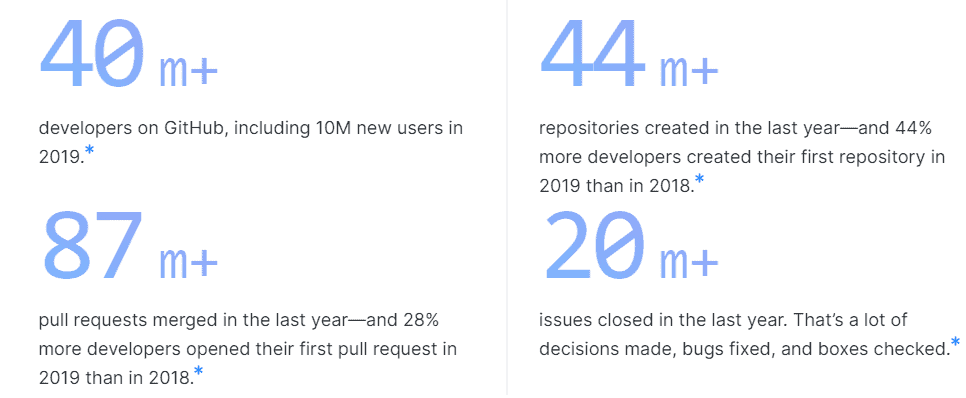
As of July 2026, GitHub is the largest host of source code in the world. It has 225 million users and over 180 million active developers. It hosts more than 630 million repositories, of which 395 million are public. Over 90% of the Fortune 500 use GitHub.
GitHub Business Model
GitHub follows the freemium model where it allows the creation of unlimited – public & private – repositories for free. You need to pay a fee to obtain additional GitHub features such as more bandwidth, more storage, better organizational tools, and customizations.
Which brings us to –
How does GitHub work and who are its key partners?
How Does GitHub Work?
GitHub provides optimized versions of Git’s features – these are seen as the fork, pull request and merge.
- The “fork” option allows for anybody to copy another’s repository along with their version history and work on it.
- Once done with your work, you can share your newly created or edited repo with the original owner using the “pull request”.
- This allows for the original owner to review the code and the changes made and if needed can even include your changes to his repo using “merge”.
GitHub’s Key Partners
Open-source Community
The open-source community is a major component of GitHub and its services. This is further enhanced by the fact that GitHub’s fundamentals are based on open-source Git. Some of the open-source projects on GitHub not only have thousands of contributors but are also the main dependencies for millions of other repositories.
Developers & IT Industry
Individual developers and the IT industry are also the major users of GitHub. Pretty much most big-name players in the IT and tech industry such as Google, Microsoft, Facebook, and Twitter host their projects on GitHub.
GitHub’s Operating Model
GitHub’s approach to providing a version control system platform is quite simple. GitHub allows its users to be able to –
- Create their repositories

- Make commits – GitHub lingo for uploading or editing files

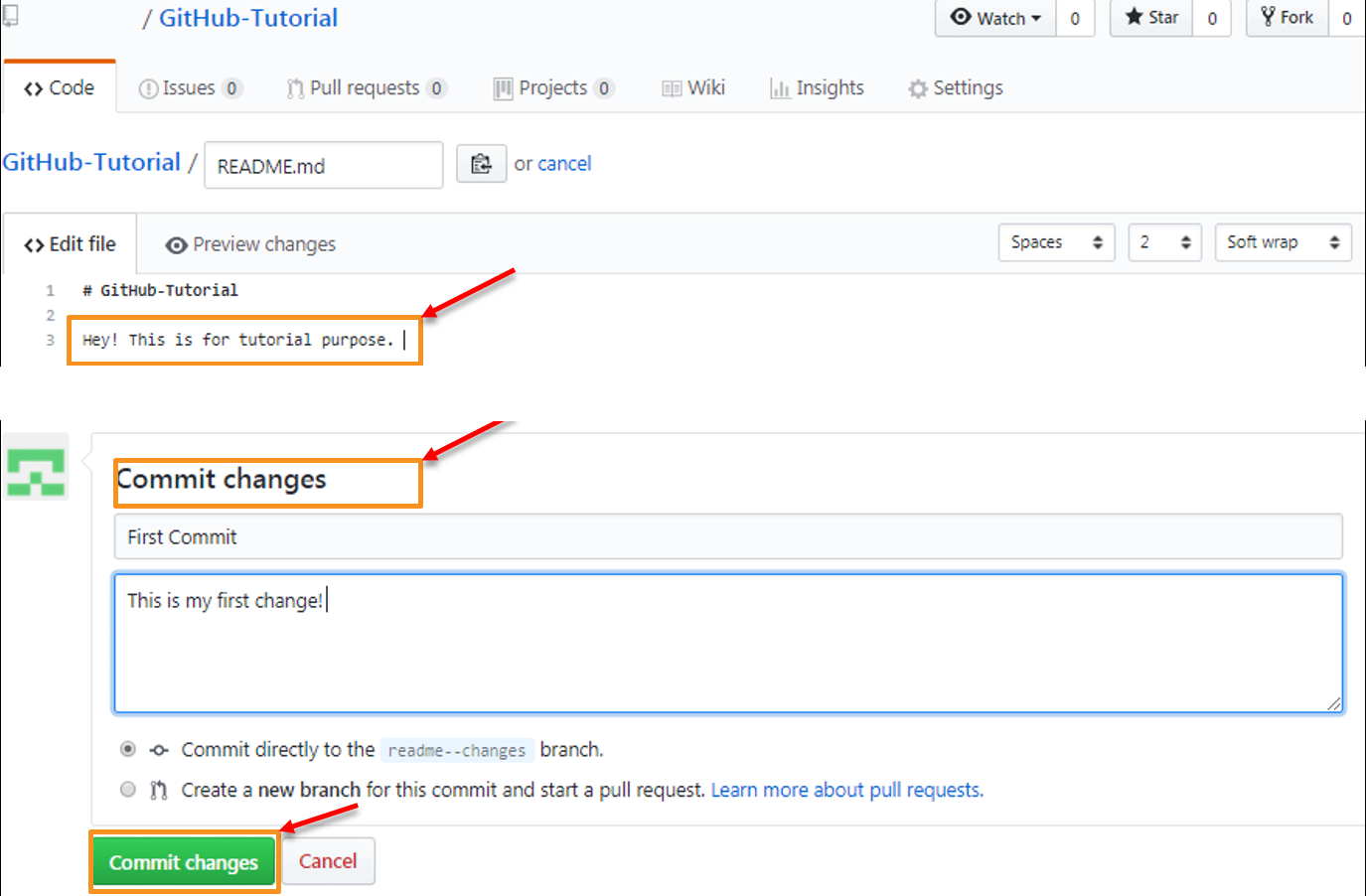
- Create branches of repositories

- Clone, download and fork repositories


All of this is powered by the underlying Git platform. These are the overlying general features available to all of the users of GitHub.
This raises the question –
How does GitHub make money if it allows free accounts itself to create an unlimited number of public and private repositories?
How Does GitHub Make Money | GitHub Revenue Model
Subscription Plans
GitHub offers a host of premium subscription plans that allow its users access to increased cloud storage and customizations. Here are the different GitHub plans –
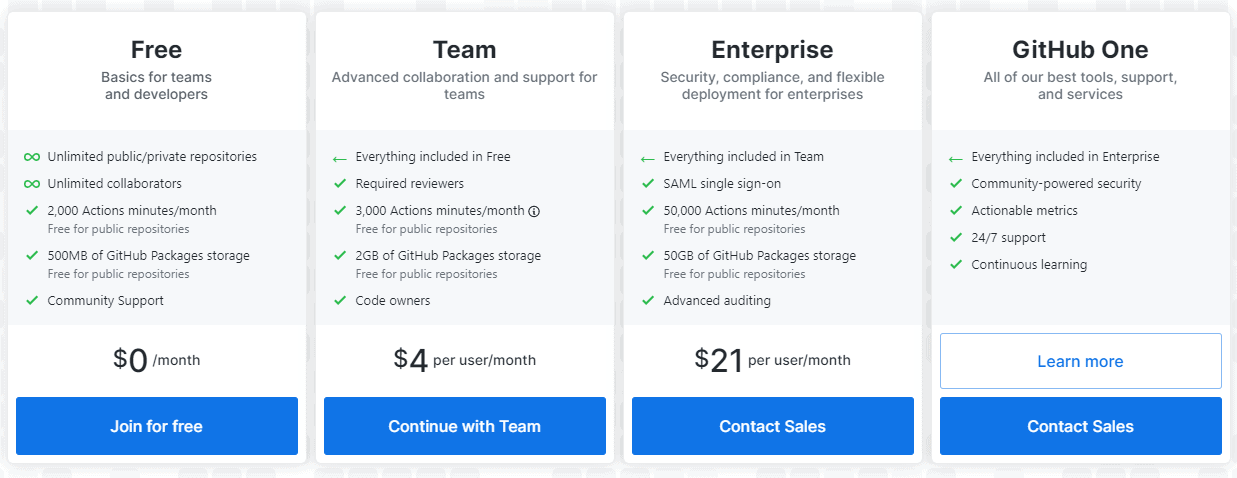
- GitHub Free – The GitHub Free plan allows for its users to be able to create unlimited public as well as private repositories and share it with any number of collaborators. The GitHub Free plan also offers users 500MB of storage for their packages and 2,000 action minutes per month.
- GitHub Team – The GitHub Team plan is priced at $4 per user/month and provides everything GitHub Free offers along with team access controls, 2GB of GitHub Packages storage, 3,000 action minutes per month, GitHub security advisories – allows the creation of private security advisory to fix vulnerabilities.
- GitHub Enterprise – The GitHub Enterprise plan, with GitHub Enterprise pricing at $21 per user/month, is a customizable and made-to-order version of the GitHub Team plan along with 50GB of GitHub Packages storage, 50,000 action minutes per month, advanced auditing provisions, and other GitHub features.
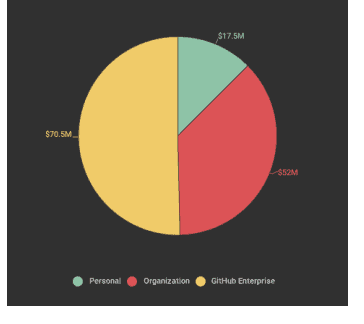
Enterprise subscriptions are a major revenue source for GitHub, though the company does not disclose a detailed revenue breakdown by plan.
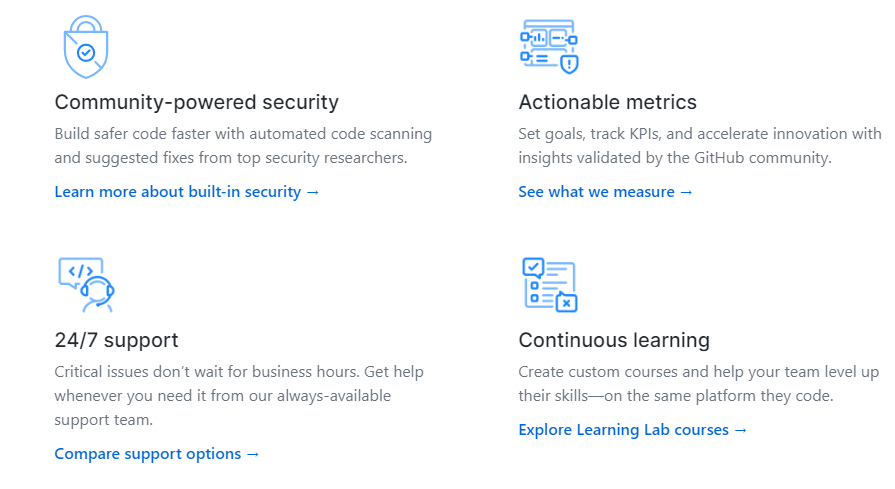
GitHub One – The GitHub One plans is more oriented towards large enterprises and is a made-to-order version of the GitHub Enterprise plan. It brings along with it everything that the GitHub Enterprise plan offers along with additional features such as community-powered security, availability of 24/7 support, actionable metrics and continuous learning abilities.
GitHub Copilot
GitHub Copilot is an AI-powered coding assistant. It has evolved from simple code completion into an agentic development platform. The Copilot coding agent runs independently in the background to complete assigned tasks, similar to a peer developer.
The numbers behind this shift are striking. GitHub Copilot now has 50 million users, and its revenue accelerated over 60% quarter-over-quarter in Q4 FY2026. GitHub’s overall revenue grew approximately 40% year-over-year during the same period, driven primarily by Copilot adoption. One in three pull requests on GitHub now involves an AI agent. Microsoft describes the platform as built for the “agentic era.”
For individuals, Copilot offers four tiers: Free ($0), Pro ($10/month), Pro+ ($39/month), and Max ($100/month). Teams can sign up for Business at $19 per user per month or Enterprise at $39. Starting June 1, 2026, all plans moved to usage-based billing. Premium request units were replaced by GitHub AI Credits consumed based on token usage. Code completions and Next Edit suggestions remain included in all plans without consuming AI Credits.
GitHub Marketplace
GitHub also provides, as part of its GitHub Business Model, a standalone service that it calls Marketplace which allows for users to be able to search, purchase and download applications as well as share their applications on the platform.
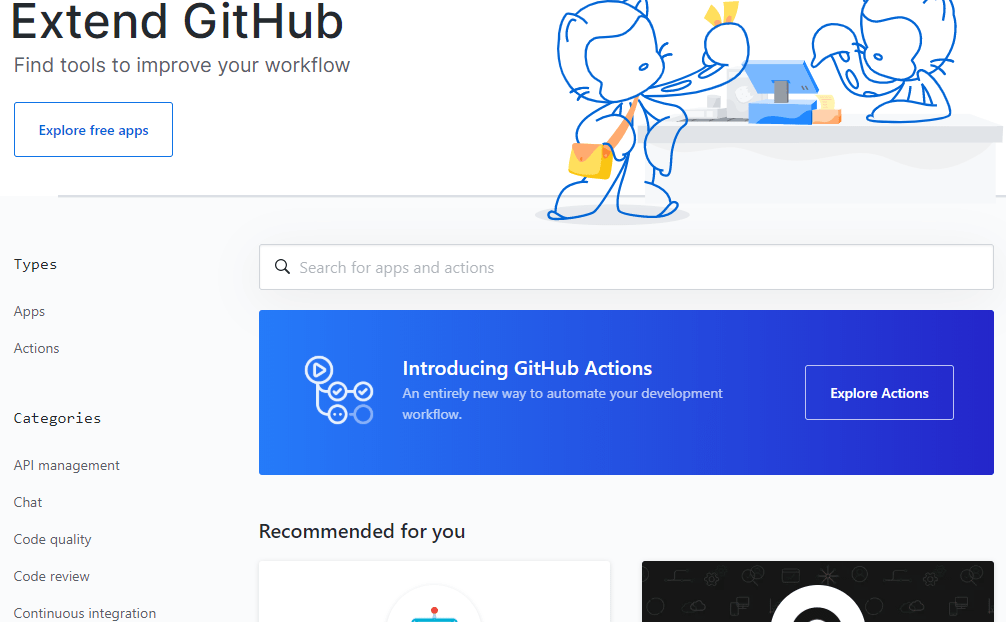
GitHub takes a 25% cut out of every sale made on the GitHub Marketplace.
Merchandising
The GitHub Shop that sells GitHub merchandise which adds up into its revenue stream.
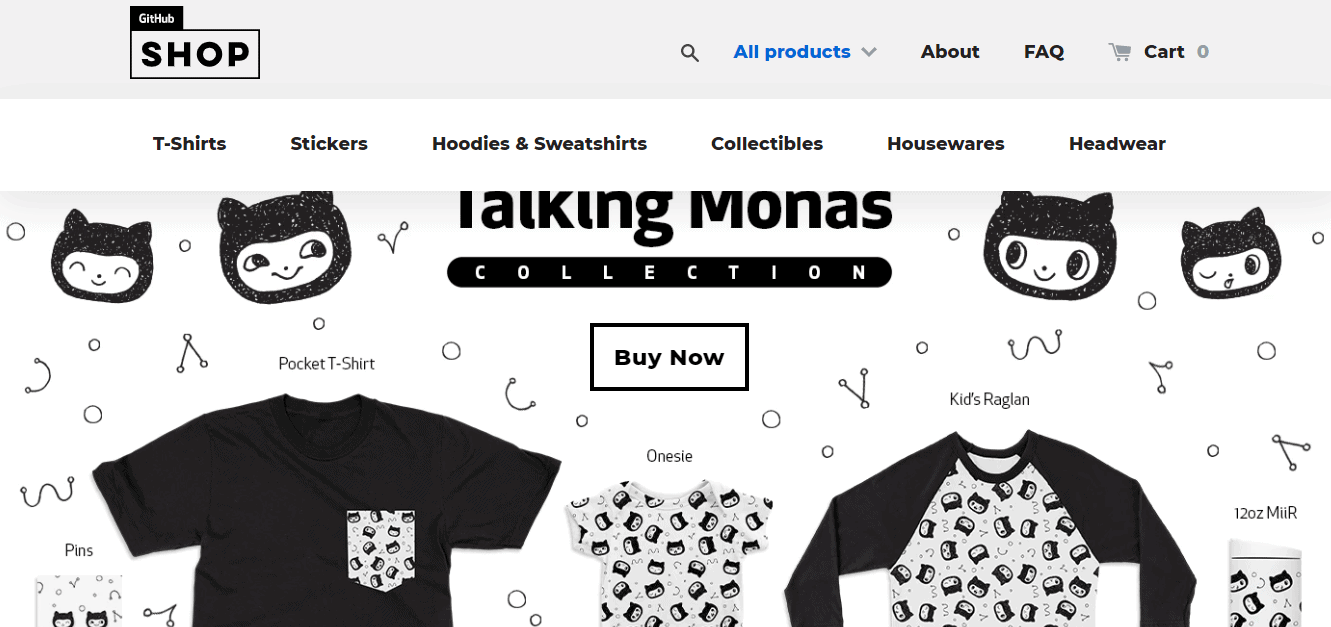
The GitHub Shop has various merchandise like – T-shirts, stickers, hoodies, sweatshirts, collectable, housewares and headwear.
Final Thoughts
GitHub started as a straightforward hosting platform for Git repositories. It has since grown into an AI-powered development hub with 225 million users and over 630 million repositories. Open-source projects and major companies alike still call it home.
Copilot reshaped the business model entirely. Revenue now comes from subscriptions, usage-based AI billing, marketplace commissions, and enterprise solutions. Copilot drives 60%+ quarter-over-quarter growth, and one in three pull requests now involves AI agents.
The platform popularized open-source collaboration and gave developers a stage to showcase their work. What started as Git hosting has become the foundation of the agentic development era.