
OpenAI’s valuation has gone from $300 billion to $730 billion in less than a year. That kind of acceleration does not happen on hype alone.
The numbers behind it are just as striking: 900 million weekly active users as of February 2026, a $40 billion funding round confirmed by CNBC as the largest private tech raise on record, and more than 2.5 billion prompts processed every single day. These OpenAI statistics from 2026 track a company moving faster than most industries can process.
Here is what the data shows about where the money is coming from, how fast the user base is growing, and what that means for the broader AI market.
Key OpenAI Statistics for 2026
OpenAI’s trajectory in 2025 and into 2026 is defined by one compounding fact: every major metric, from users to revenue to valuation, grew faster than the previous record it had just set.
- 900 million weekly active users globally as of February 2026, up from 800 million in October 2025
- $20 billion+ in annualized revenue reached in 2025, confirmed by OpenAI CFO Sarah Friar, up from the $13 billion target set mid-year
- $300 billion post-money valuation confirmed after the March 2025 funding round
- $40 billion raised in March 2025, the largest private tech funding round on record at the time
- $57.9 billion in total funding raised across 11 rounds as of May 2025, with additional rounds closing in late 2025 and 2026
- 1 million+ business customers worldwide using OpenAI products, confirmed by OpenAI in November 2025
- 2.5 billion daily queries processed globally across all ChatGPT users
- 36.5% of U.S. businesses adopted OpenAI services by July 2025
- 45.3% market share among daily U.S. mobile app users as of January 2026, down from 69.1% in January 2025, per Apptopia data reported by Fortune
- 330 million daily queries from U.S. users alone, representing roughly 13% of global query volume
- 49% of U.S. companies report using ChatGPT regularly in their workflows, per a ResumeBuilder/Digital Silk survey
- ChatGPT adoption growth rates in the lowest-income countries were more than 4x those in the highest-income countries by May 2025, according to OpenAI’s own research
OpenAI Revenue Statistics and Financial Performance
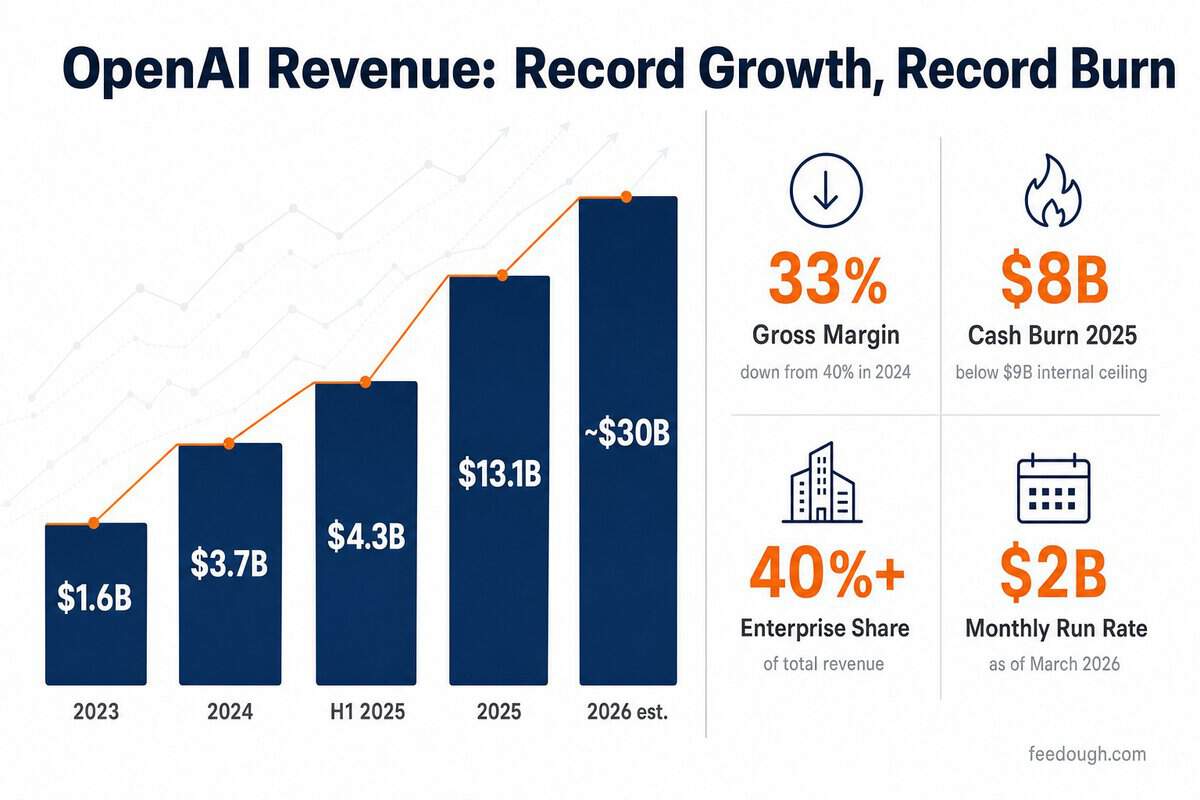
OpenAI grew from $1.6 billion in revenue in 2023 to $13.1 billion in 2025. That is an 8x increase in two years. The losses kept pace: the company burned through roughly $8 billion in cash during 2025 alone, even while exceeding its own internal revenue targets.
Period | Revenue | Key Milestone |
|---|---|---|
Full-year 2023 | $1.6 billion | ARR at $2 billion by year-end |
Full-year 2024 | $3.7 billion | Net loss of $5 billion on same-year revenue |
H1 2025 | $4.3 billion | Roughly 16% above total 2024 revenue |
Full-year 2025 | $13.1 billion | Exceeded $10 billion internal target; ARR crossed $20 billion |
Monthly run rate (March 2026) | $2 billion/month | Implies $24 billion annualized pace |
2026 projection | ~$30 billion | Revised upward from original $29.4 billion internal target |
These OpenAI revenue statistics show a 3.2x annualized growth rate since 2023, a pace that Epoch AI’s Companies Data Hub describes as among the fastest in tech history. But the revenue mix and margin picture are harder to ignore:
- ChatGPT accounts for roughly 70% of total revenue, with enterprise solutions making up the remaining 30%
- The enterprise segment now exceeds 40% of total revenue and is on track to reach parity with the consumer segment by end of 2026, per OpenAI’s March 2026 funding announcement
- Adjusted gross margin fell to 33% in 2025, down from 40% in 2024, as inference costs quadrupled during the year
- Cash burn in 2025 reached approximately $8 billion, below the company’s own $9 billion internal ceiling
The margin compression is structural, not incidental. Every new model generation requires more compute at inference, and OpenAI is deploying more capable models faster than it is reducing the cost to run them. Revenue scaling at 8x does not offset a gross margin falling 7 points in a single year.
OpenAI Valuation and Funding Statistics
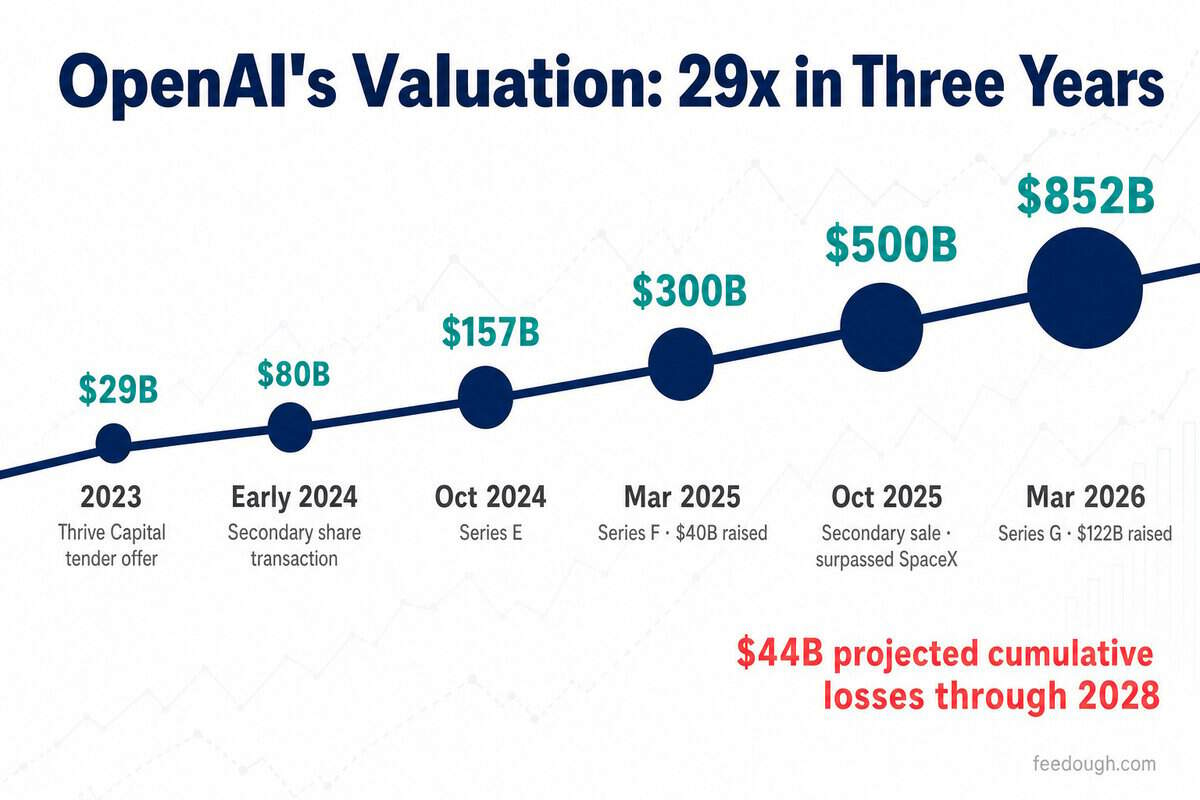
No private company has appreciated faster. OpenAI went from a $29 billion valuation in 2023 to $852 billion by March 2026, a 29x increase in roughly three years. The funding that powered that climb is equally without precedent: $180 billion raised across 13 rounds, including two successive rounds that each broke the record for the largest private fundraise in history.
Date | Valuation | Round / Event |
|---|---|---|
2023 | $29 billion | Thrive Capital-led tender offer |
Early 2024 | $80 billion | Secondary share transaction |
October 2024 | $157 billion | Series E funding round |
March 2025 | $300 billion | Series F; $40 billion raised, led by SoftBank ($30 billion) |
October 2025 | $500 billion | Secondary share sale; surpassed SpaceX as most valuable private company |
March 2026 | $852 billion | Series G; $122 billion raised, led by SoftBank, Amazon, and Nvidia |
These OpenAI valuation statistics carry a sharp contradiction at their core. The $852 billion figure sits alongside a projected $14 billion net loss for 2026 alone and cumulative losses of $44 billion expected through 2028. Investors are not betting on current profitability. They are betting that whoever controls the leading general-purpose AI infrastructure will not be displaced, and that the window to take that position is closing. SoftBank, Amazon, and Nvidia collectively put more than $150 billion into OpenAI across two years on exactly that thesis.
ChatGPT User Growth Statistics
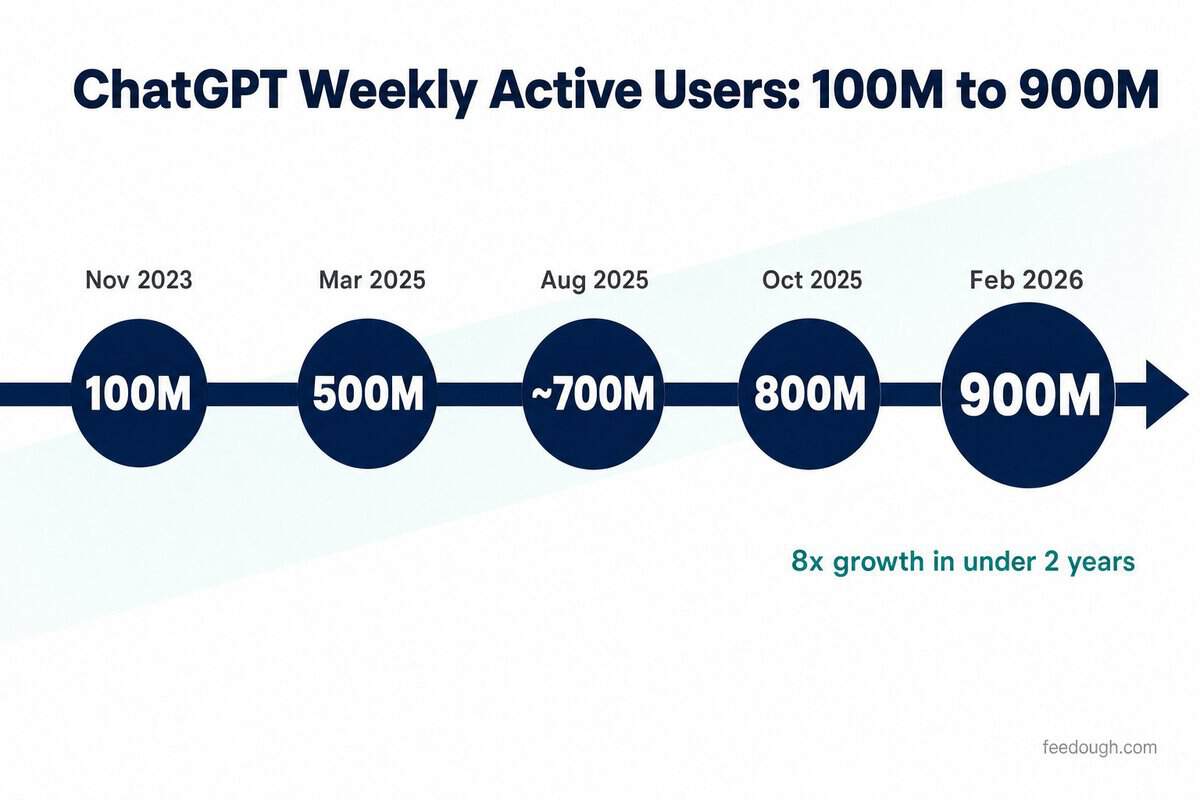
ChatGPT hit 100 million weekly active users in November 2023. By February 2026, that number was 900 million. Almost no consumer platform in history has added 800 million users in roughly 27 months.
The pace did not hold steady: it accelerated. The jump from 500 million to 800 million weekly users took just seven months (March to October 2025), and year-over-year growth as of August 2025 was running at more than 4x, up from 2.5x at the same point in 2024. These ChatGPT user growth statistics also track where that growth is concentrated, and the answer is not where most people assume.
Date | Weekly Active Users | Notable Context |
|---|---|---|
November 2023 | 100 million | First major WAU milestone disclosed publicly |
End of March 2025 | 500 million | Baseline for seven-month sprint comparison |
August 2025 | ~700 million | Year-over-year growth running at 4x+, per CNBC |
October 2025 | 800 million | 8x growth from November 2023 in under two years |
February 2026 | 900 million | More than doubled from 400 million in February 2025 (125% YoY) |
The demographic and geographic spread behind these numbers adds context the headline figures obscure. Women now make up 52% of identifiable ChatGPT users (up from 37% in January 2024), signaling a platform that has moved well past its early tech-enthusiast base. Geographically, the US accounts for roughly 18% of total users, with India at approximately 9% and Brazil at 5%. More telling: adoption growth in the lowest-income countries is running at more than 4x the rate seen in the highest-income countries, per OpenAI’s own September 2025 consumer usage study. The scale at which this is happening (3 billion messages sent per day across all products as of August 2025) suggests the platform is no longer competing for attention against other AI tools. It is competing against not using AI at all.
ChatGPT Usage Statistics: How People Actually Use It
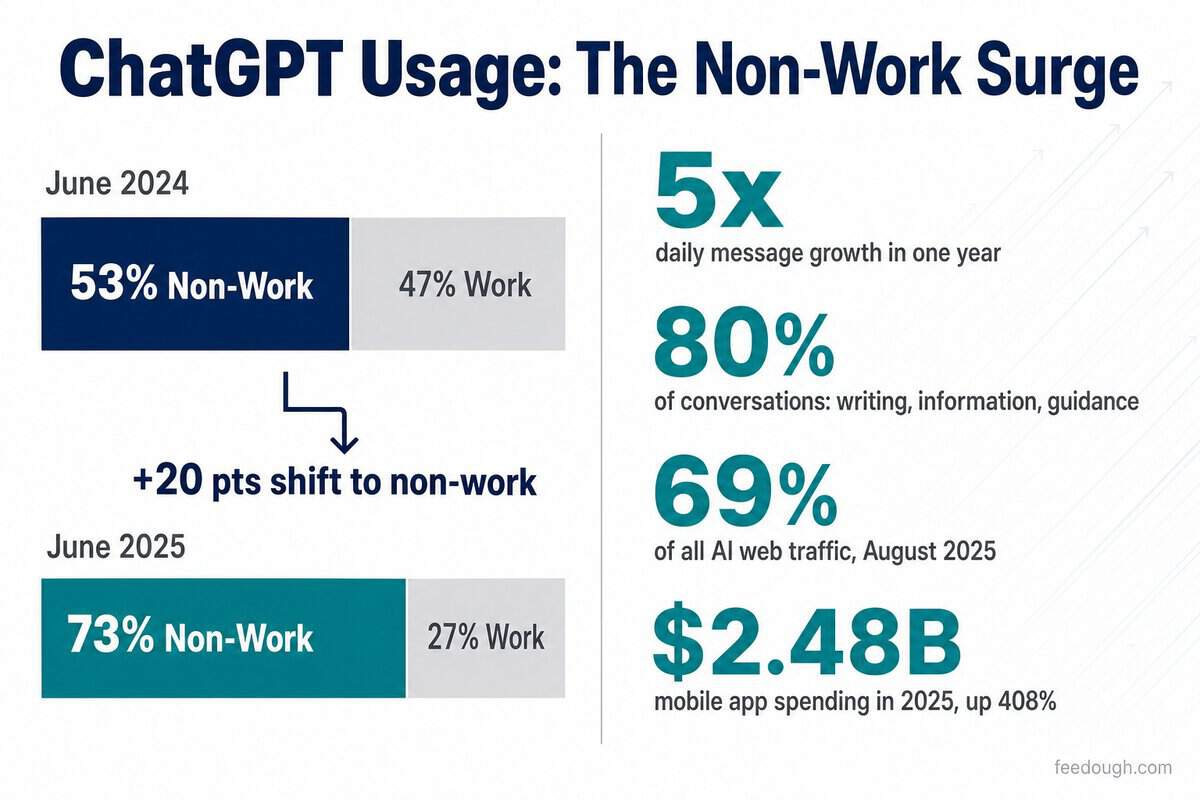
The headline user numbers get the attention. But the usage data tells a more unexpected story: the platform’s explosive message growth between 2024 and 2025 was driven primarily by non-work activity, not professional use. That inversion matters for how the platform’s long-term role gets understood.
Message Category | Daily Volume (June 2024) | Daily Volume (June 2025) | Share Shift |
|---|---|---|---|
Non-work messages | 238 million (53%) | 1,911 million (73%) | +20 percentage points |
Work-related messages | 213 million (47%) | 716 million (27%) | -20 percentage points |
Total daily messages | 451 million | 2,627 million | +483% year-over-year |
Total daily messages grew more than 5x in a single year, according to OpenAI’s largest-ever consumer usage study published as an NBER working paper in September 2025. Work-related volume nearly tripled in absolute terms. But non-work messages grew 8x, pulling the share distribution sharply toward personal and conversational use. These ChatGPT usage statistics also break down what users are actually doing when they open the platform:
- Nearly 80% of all conversations fall into three categories: practical guidance (29%), seeking information, and writing
- 40% of all work-related messages involve writing tasks, with two-thirds of those asking ChatGPT to modify existing text rather than generate new content
- ChatGPT accounted for 69% of all AI tools web traffic in August 2025, reaching 5.846 billion website visits, per Similarweb
- The mobile app generated $2.48 billion in worldwide consumer spending in 2025, a 408% year-over-year increase from $487 million in 2024
- ChatGPT became the fastest app to reach 1 billion global downloads across iOS and Google Play combined, per Sensor Tower’s State of AI Apps Report 2025
The editing-over-generating finding in writing tasks points to a platform that has settled into a role as a revision layer, not a replacement for original thought. Users are bringing their own work and asking for it to be improved, not asking ChatGPT to start from scratch.
OpenAI Traffic Statistics: openai.com vs. chatgpt.com
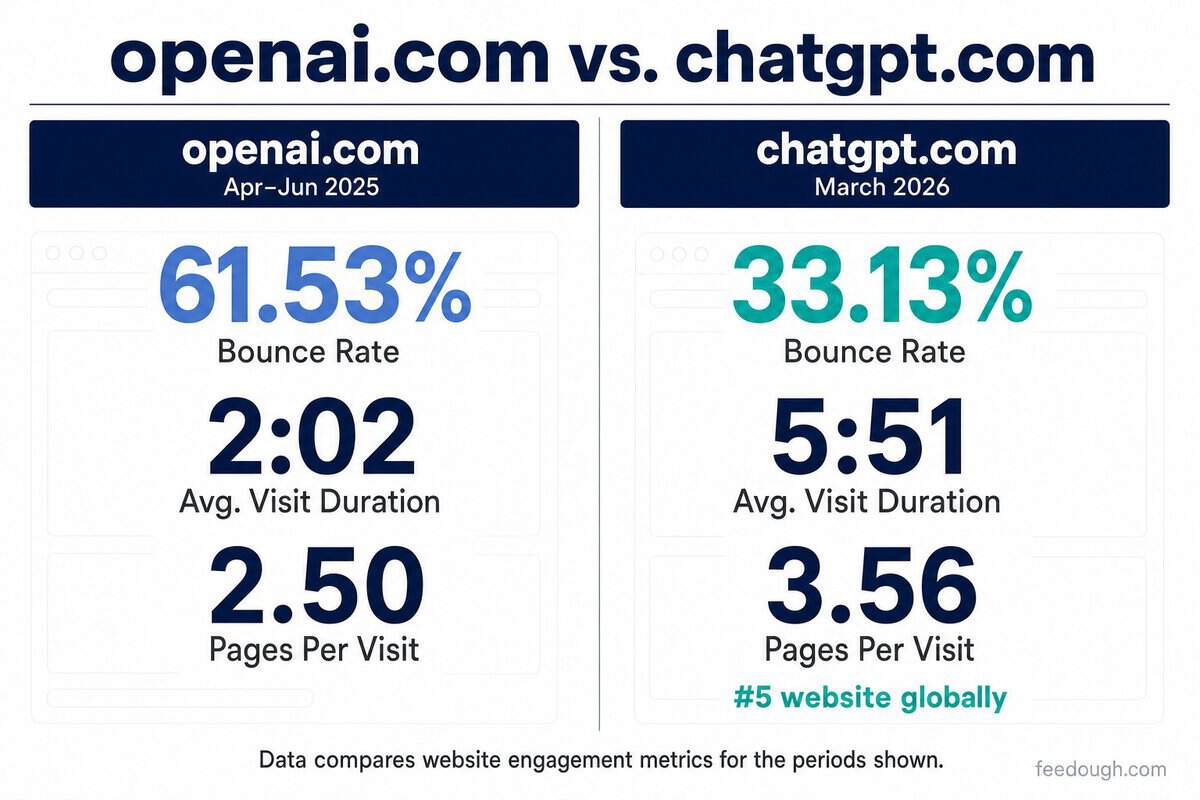
chatgpt.com ranked 5th among all websites on earth in March 2026, sitting behind only Google, YouTube, Facebook, and Instagram. That context reframes every openai.com engagement metric: the corporate site is a waypoint. The product is where users actually live.
These OpenAI traffic statistics cover both properties separately, because pooling them obscures what each one shows. openai.com pulls in massive visitor volume with shallow engagement. chatgpt.com shows the opposite: fewer absolute visits than the corporate site, but session behavior that looks more like a productivity tool than a web destination.
Metric | openai.com (Apr–Jun 2025) | chatgpt.com (March 2026) |
|---|---|---|
Monthly visits | 663.6 million | Not separately reported (ranked #5 globally) |
Unique monthly visitors | 237.7 million (2.89% of global population) | Not separately reported |
Avg. visit duration | 2 minutes 2 seconds | 5 minutes 51 seconds |
Pages per visit | 2.50 | 3.56 |
Bounce rate | 61.53% | 33.13% |
Visits per unique visitor | 2.79 | Not separately reported |
Largest social traffic source | YouTube (42.18% of social referrals) | Not separately reported |
The bounce rate gap is the most telling signal. Nearly 62% of openai.com visitors leave after a single page, a pattern consistent with users landing on a blog post or news item and moving on. chatgpt.com’s 33% bounce rate, combined with nearly six-minute average sessions, reflects a platform people are opening to complete tasks. YouTube driving 42% of openai.com’s social referrals reinforces the same point: most traffic to the corporate site arrives from content discovery, not from people seeking the product itself.
ChatGPT User Demographics Statistics
ChatGPT’s early user base looked like most consumer tech launches: young, male-skewed, and concentrated in high-income English-speaking markets. By mid-2025, that profile had changed on almost every dimension. The platform’s gender split has reversed, its age distribution has broadened significantly upward, and its fastest-growing users are in lower-income countries.
These ChatGPT user demographics statistics break down who is on the platform today across the four dimensions where the shift is most visible:
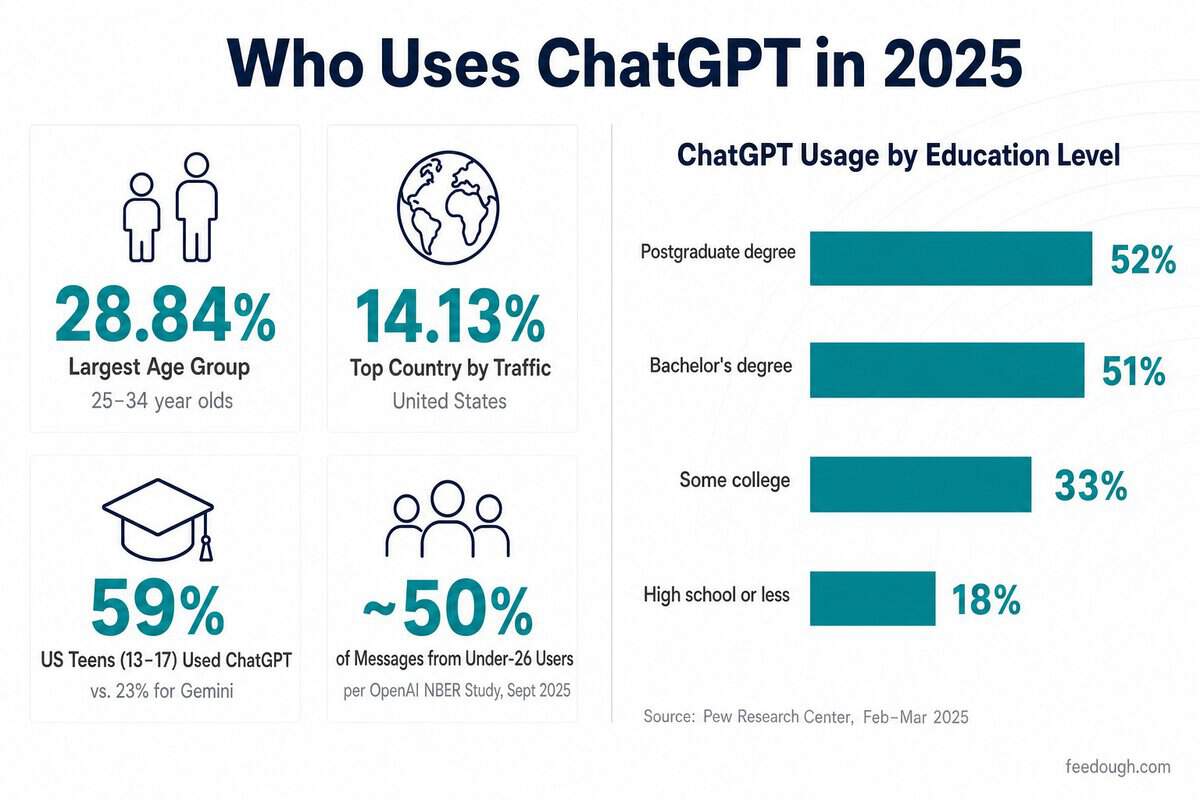
- Age: the 25–34 bracket remains the largest single group at 28.84%, with 18–24-year-olds at 24.81%. Together, users under 35 account for more than half the platform. Adults 45 and older now represent more than a quarter of all users.
- Gender: the platform launched with a clear male skew (53.84% male, 46.16% female). By July 2025, that skew had not only narrowed but reversed, per OpenAI’s September 2025 NBER consumer usage study.
- Geography: the US leads at 14.13% of traffic, followed by India at 11.71% and Japan at 5.27%. The US share reflects the largest absolute user pool, but India’s proximity to the top signals where growth is concentrated.
- Teen usage: 59% of US teens ages 13–17 have used ChatGPT, per a Pew Research Center survey conducted September–October 2025, more than double the rate of the next most-used chatbot (Google Gemini at 23%).
Education Level | Share of US Adults Who Have Used ChatGPT |
|---|---|
Postgraduate degree | 52% |
Bachelor’s degree | 51% |
Some college | 33% |
High school degree or less | 18% |
US adults overall (2025) | 34% |
US adults under 30 | 58% |
The education gradient is among the sharpest demographic divides in the platform’s US data, per Pew Research Center’s February–March 2025 survey of 5,123 adults. College graduates are nearly three times as likely to have used ChatGPT as adults without a college degree. That gap partially reflects income and occupation, but it also signals that the platform’s most active use cases still skew toward knowledge work. Nearly half of all ChatGPT messages sent by adults come from users under 26, according to OpenAI’s September 2025 NBER study, suggesting age compresses the education gap at the younger end of the distribution.
ChatGPT Business Usage Statistics
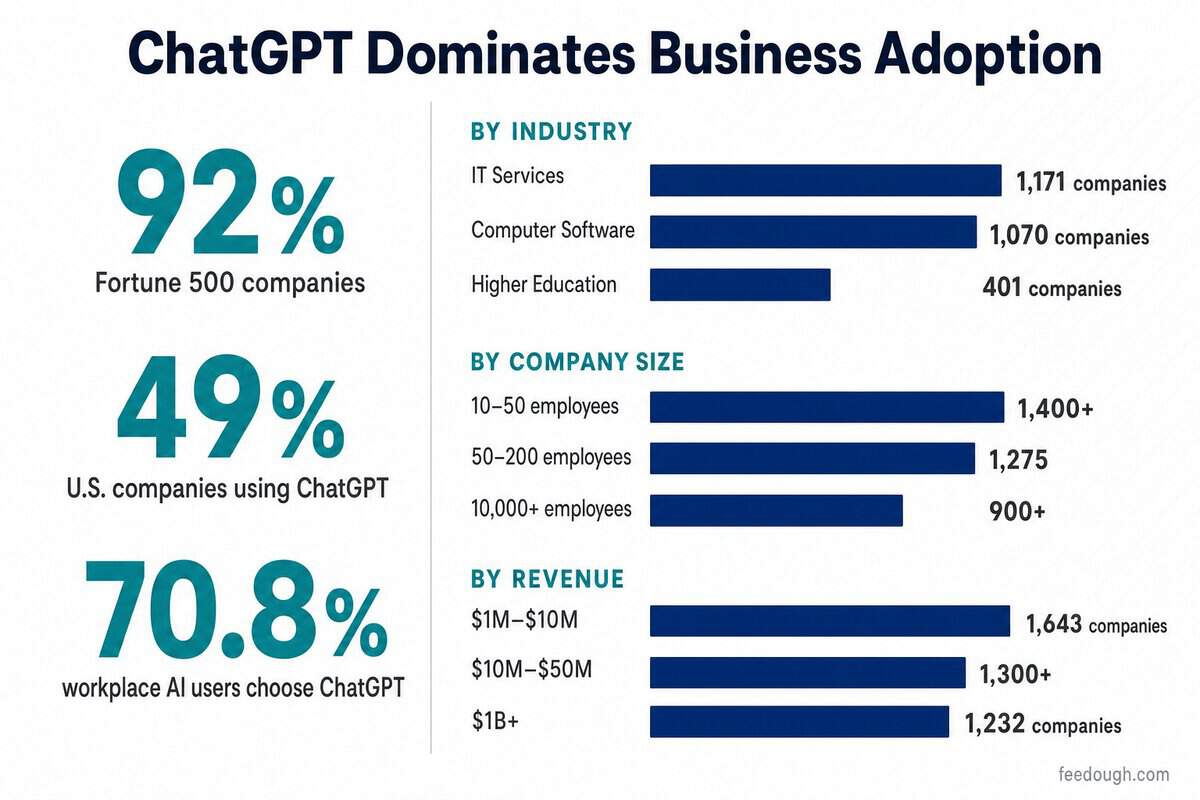
Among Fortune 500 companies, ChatGPT adoption has reached 92%. Among all U.S. businesses, it sits at 49%, with another 30% planning to adopt soon. The gap between enterprise and small-business adoption is the defining fault line in how this technology is spreading through the economy.
| Segment | Category | Company Count (ChatGPT Users) |
|---|---|---|
| By Industry | IT Services | 1,171 companies |
| Computer Software | 1,070 companies | |
| Higher Education | 401 companies | |
| By Company Size | 10–50 employees | 1,400+ |
| 50–200 employees | 1,275 | |
| 10,000+ employees | 900+ | |
| By Revenue | $1M–$10M | 1,643 companies |
| $10M–$50M | 1,300+ | |
| $1B+ | 1,232 companies |
These ChatGPT business usage statistics extend beyond adoption counts into how frequently and exclusively employees are using the platform. Among workplace AI users, 70.8% have chosen ChatGPT as their primary tool, per a survey by Exploding Topics reported by FatJoe in 2026. More than half of workplace AI users engage with it four or more days per week, and daily usage among knowledge workers doubled in the year to mid-2025, according to Stanford research cited in OpenAI’s August 2025 workplace usage report. That same report, drawing on Pew Research Center data, found that 28% of employed U.S. adults were using ChatGPT at work by mid-2025, up from just 8% two years earlier. The 22% of workplace users who interact daily, with another 12% engaging weekly, reflects a platform that has moved from occasional tool to embedded workflow component for a meaningful share of the workforce.
OpenAI Product and GPT-5 Pricing Statistics
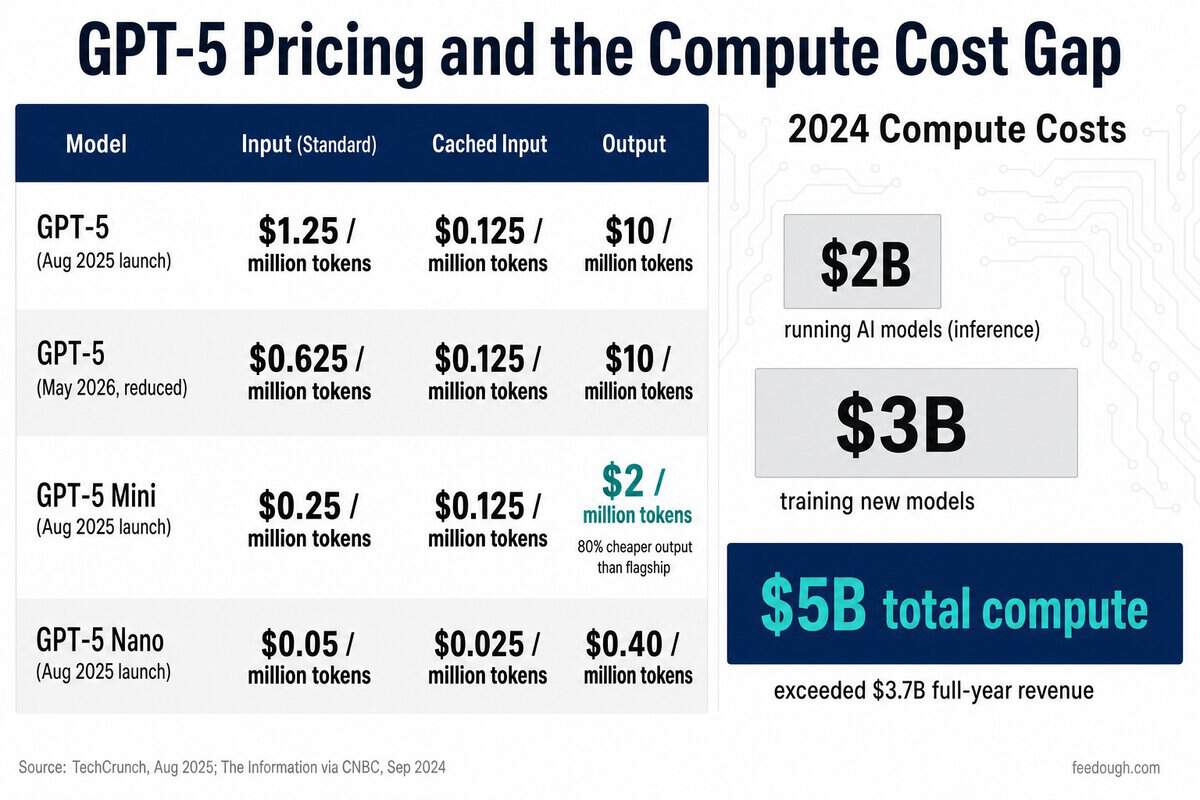
When GPT-5 launched on August 7, 2025, TechCrunch called it a potential price war starter. At $1.25 per million input tokens, it undercut prevailing frontier model rates by a wide margin. By May 2026, OpenAI had cut that price in half for the original GPT-5 model, reassigning the $1.25 rate to the newer GPT-5.1, in a compression cycle that shows no sign of stabilizing.
Model | Input (Standard) | Input (Cached) | Output |
|---|---|---|---|
GPT-5 (at launch, Aug 2025) | $1.25 / million tokens | $0.125 / million tokens | $10 / million tokens |
GPT-5 (May 2026, reduced) | $0.625 / million tokens | $0.125 / million tokens | Not separately updated |
GPT-5.1 (May 2026) | $1.25 / million tokens | Not separately reported | Not separately reported |
GPT-5 Mini (at launch, Aug 2025) | $0.25 / million tokens | Not separately reported | $2 / million tokens |
GPT-5 Mini’s output tokens cost 80% less than the flagship model at launch ($2 vs. $10 per million), giving enterprise developers a viable cost path for high-volume applications. These GPT-5 pricing statistics reflect a deliberate strategy: compress access costs to accelerate adoption while the compute bill continues to grow underneath. The 2024 compute breakdown from The Information illustrates exactly how steep that bill is:
- $2 billion spent running AI models (inference costs) in 2024
- $3 billion spent training new models in 2024
- $5 billion in total 2024 compute costs, exceeding the company’s entire annual revenue of $3.7 billion that year
Lowering API prices accelerates the adoption that justifies the next funding round. It does not reduce the compute cost per query.
OpenAI Traffic Sources Statistics
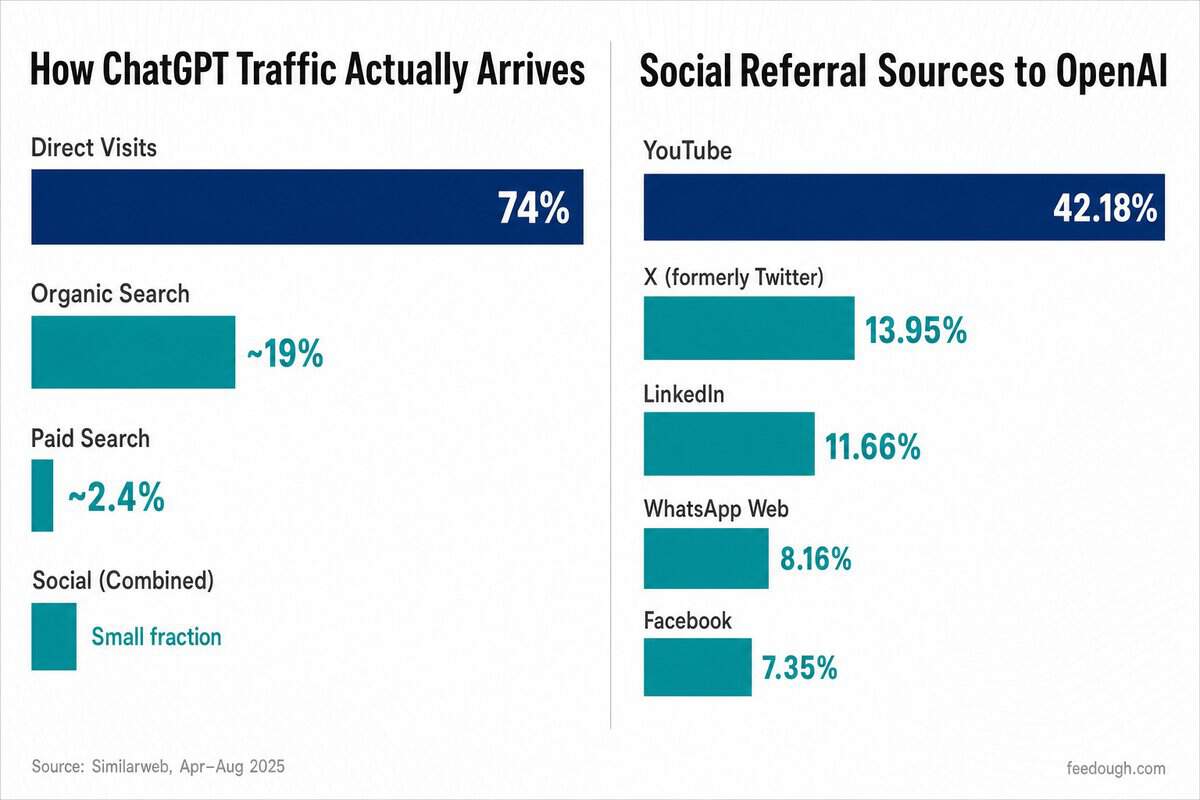
Most people assume social media drives AI tool discovery. For chatgpt.com, 74% of U.S. traffic in August 2025 arrived directly, with no referral source at all, per Similarweb data published on the Similarweb blog in September 2025. Organic search added roughly 19%. Social platforms, combined, contributed a small fraction.
Traffic Channel | Share of chatgpt.com U.S. Traffic (August 2025) |
|---|---|
Direct visits | 74% |
Organic search | ~19% |
Paid search | ~2.4% |
Social referrals (combined) | Remainder |
Within the social referral share, these OpenAI traffic sources statistics reveal a concentration that reflects how people learn about AI tools: not through feeds, but through demonstration content. The breakdown of desktop social media traffic to the OpenAI website between April and June 2025 is as follows:
Social Platform | Share of Desktop Social Referral Traffic (Apr–Jun 2025) |
|---|---|
YouTube | 42.18% |
X (formerly Twitter) | 13.95% |
LinkedIn | 11.66% |
WhatsApp Web | 8.16% |
Facebook | 7.35% |
YouTube’s share is more than three times that of the next platform. Tutorials, walkthroughs, and capability demonstrations on video outperform every text-based or conversational social channel combined, which tells you more about how AI tool awareness spreads than any paid acquisition data could.
The geographic spread of chatgpt.com users shows a similar concentration at the top: the United States accounted for 14.72% of ChatGPT users between April and June 2025, rising to 15.09% by August 2025, per Similarweb. India followed at 9.02% (rising to 9.31% by August 2025). ChatGPT referral traffic to third-party websites grew 52% year-over-year from September to November 2025. Over the same period, Google Gemini’s referral traffic grew 388%, according to Similarweb data shared with Digiday in December 2025. That asymmetry is the most important competitive signal in the traffic data: ChatGPT’s referral footprint is large, but Gemini is closing the gap faster than the headline user numbers suggest.
GPT-5 Performance and Adoption Statistics
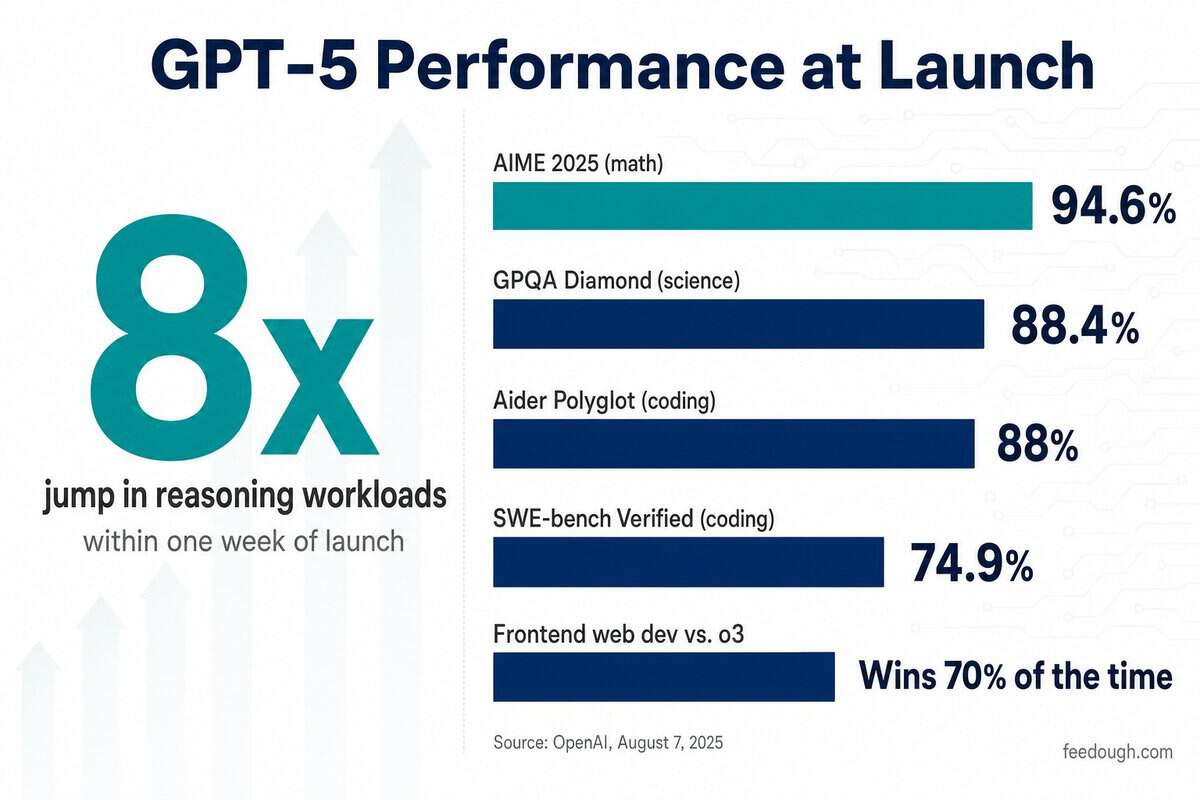
Within one week of GPT-5’s August 7, 2025 launch, reasoning workloads on OpenAI’s platform increased eightfold. That is not a benchmark result. It is what enterprises actually did when they got their hands on the model, and it is a more reliable signal of capability than any leaderboard position.
Benchmark | GPT-5 Score | Context |
|---|---|---|
SWE-bench Verified (coding) | 74.9% | State-of-the-art at launch, per OpenAI |
Aider Polyglot (coding) | 88% | State-of-the-art at launch, per OpenAI |
AIME 2025 (math, no tools) | 94.6% | Up from GPT-4o’s 42.1% on the same benchmark |
GPQA Diamond (PhD-level science, no tools) | 88.4% | GPT-5 Pro; state-of-the-art at launch |
MMMU (college-level multimodal) | 84.2% | Per OpenAI’s August 7, 2025 launch documentation |
Frontend web development vs. o3 | Wins 70% of the time | Internal testing; uses 22% fewer output tokens than o3 |
The benchmark picture is consistent: GPT-5 set new state-of-the-art results across coding, math, and science tasks at launch. The AIME jump from 42.1% (GPT-4o) to 94.6% is the sharpest single-generation gain in the table. Epoch AI’s analysis, published August 29, 2025, placed GPT-5’s overall capability gains in the same range as the GPT-3 to GPT-4 transition, which remains the benchmark for what a generational model shift looks like. On token efficiency, GPT-5 with thinking enabled outperforms o3 while using 50 to 80% fewer output tokens across visual reasoning, agentic coding, and graduate-level scientific problem solving.
These GPT-5 adoption statistics tell the enterprise side of the story more directly. Cursor, Vercel, JetBrains, Factory, Qodo, and GitHub Copilot all made GPT-5 the default model in key products within one week of launch, per CNBC reporting published August 14, 2025. Over that same period, coding and agent-building activity on OpenAI’s platform more than doubled. The 400K total context window (272K input tokens plus 128K output tokens) gave enterprise developers working with long codebases and complex document pipelines something GPT-4’s 128K window could not: room to fit the whole problem in a single call.
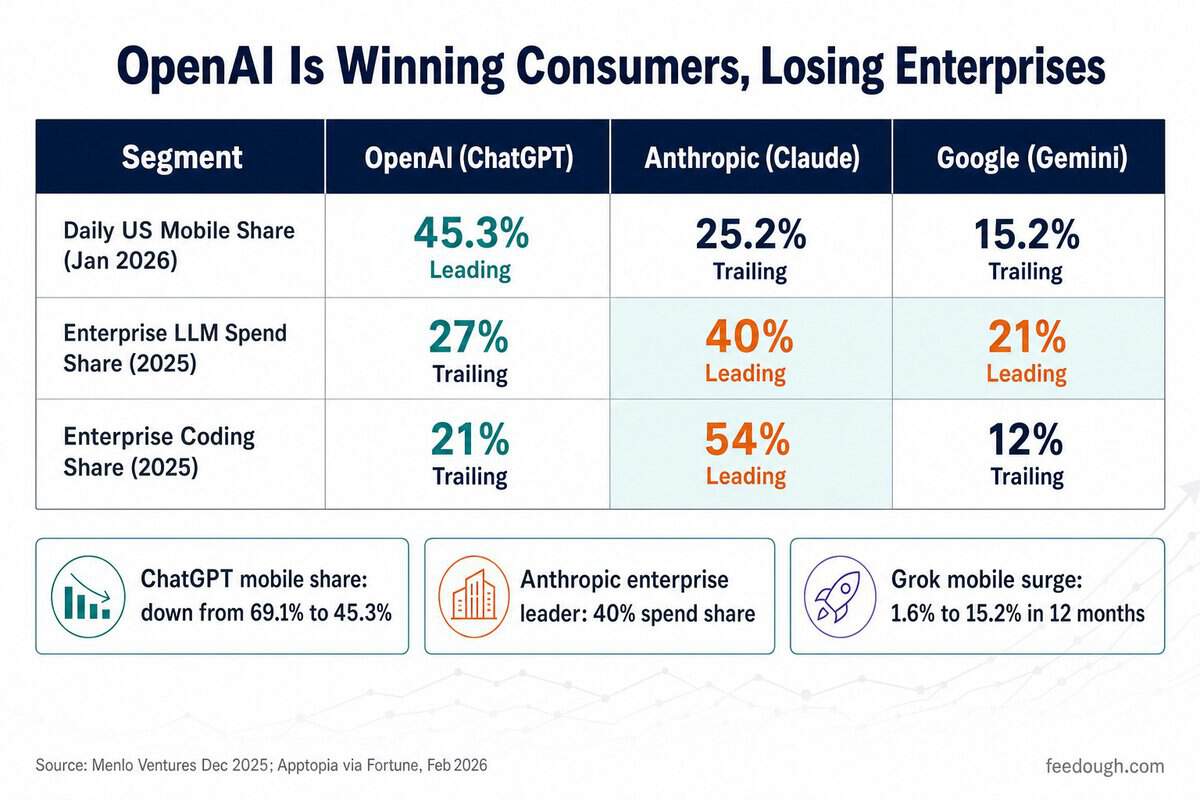
ChatGPT still leads every major consumer category. But in the enterprise segment where contract values are largest, OpenAI has already lost the top position. Anthropic holds it now, and the gap is not narrow.
Segment | OpenAI (ChatGPT) | Anthropic (Claude) | Google (Gemini) | Grok (xAI) |
|---|---|---|---|---|
AI search market share (Dec 2025) | 61.3% | Not separately reported | 13.4% | Not separately reported |
Daily US mobile app share (Jan 2026) | 45.3% (down from 69.1% in Jan 2025) | Not separately reported | 25.2% (up from 14.7%) | 15.2% (up from 1.6%) |
Enterprise LLM spend share (2025) | 27% (down from 50% in 2023) | 40% (market leader) | 21% (up from 7% in 2023) | Not separately reported |
Enterprise coding use cases (2025) | 21% | 54% (dominant) | Not separately reported | Not separately reported |
These OpenAI market share statistics show two diverging trajectories running simultaneously. The competitive movements behind each row carry their own context:
- ChatGPT’s US daily mobile app share fell 23.8 percentage points in a single year (69.1% to 45.3%), dropping below 50% for the first time, even as the overall GenAI chatbot app market grew 152% year-over-year, per Apptopia data reported by Fortune, February 2026
- Grok surged from 1.6% to 15.2% in US daily mobile share over the same 12-month period, fueled by deep integration within the X app, making it the fastest-growing AI chatbot by market share
- Anthropic’s enterprise LLM spend share rose to 40% by December 2025, up from 32% by usage share earlier in the year, with coding dominance that has been nearly uninterrupted for 18 months since Claude Sonnet 3.5’s June 2024 release
- Google Gemini grew enterprise share from 7% in 2023 to 21% in 2025; together, Anthropic, OpenAI, and Google account for 88% of all enterprise LLM API spend
- U.S. enterprise LLM API spending reached $37 billion in 2025, up more than threefold from $11.5 billion in 2024, per Menlo Ventures’ 2025 State of Generative AI in the Enterprise report (December 2025, 495 U.S. companies surveyed)
The AI market is not heading toward a single winner. OpenAI’s consumer reach remains enormous, but Anthropic owns enterprise coding, Gemini is gaining enterprise wallet share fast, and Grok has demonstrated that platform integration can compress years of user acquisition into months.
OpenAI API Usage Statistics
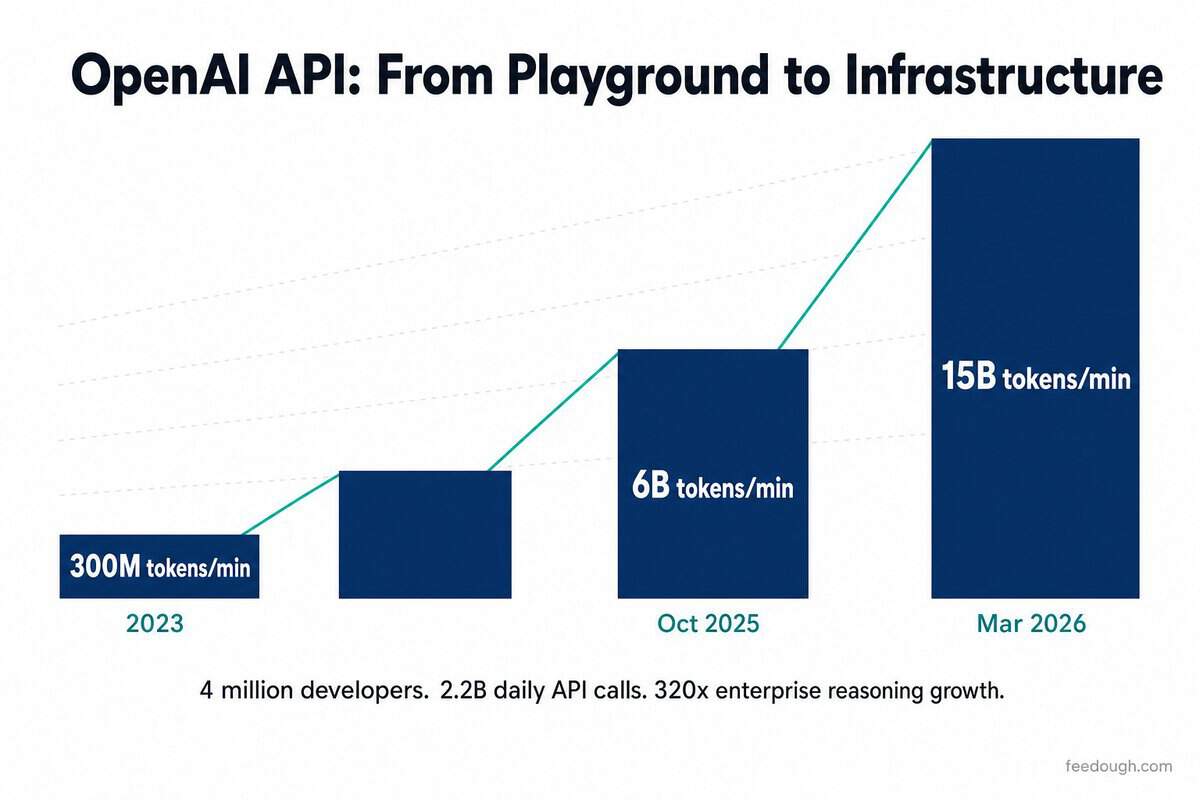
In 2023, OpenAI’s API processed 300 million tokens per minute. By March 2026, that figure was 15 billion. That 50x increase in under three years is not developer experimentation scaling up. It is production infrastructure at a scope that few cloud platforms have reached this quickly.
Metric | Earlier Baseline | Latest Figure | Source / Date |
|---|---|---|---|
Tokens processed per minute | 300 million (2023) | 15 billion (March 2026) | OpenAI DevDay Oct 2025; Panto AI Jan 2026 |
Daily API calls | 1.3 billion (2024) | 2.2 billion+ (2025) | 69% year-over-year increase |
Active developers on platform | 2 million weekly (2023) | 4 million (October 2025) | OpenAI DevDay, Sam Altman keynote, Oct 6 2025 |
ChatGPT workplace seats | Not separately disclosed | 7 million+ (as of Dec 2025) | OpenAI State of Enterprise AI 2025 Report |
ChatGPT Enterprise seat growth (YoY) | Baseline 2024 | 9x year-over-year | OpenAI State of Enterprise AI 2025 Report |
What these OpenAI API statistics do not show in a table row is the depth of that enterprise usage. Among enterprise customers, reasoning token consumption per organization increased 320x year-over-year, and ChatGPT Enterprise message volume grew 8x over the same period, per OpenAI’s State of Enterprise AI 2025 Report (December 17, 2025), which analyzed de-identified, aggregated data across more than 1 million business customers. Those numbers describe a different kind of adoption than new seat counts do. Organizations that were running lightweight queries in 2024 are now running sustained, compute-intensive reasoning workloads at scale. The developer platform’s expansion into fine-tuning, custom GPTs, and agentic workflow tools gave those enterprises the surface area to go that deep.
Enterprise and Business Adoption Statistics
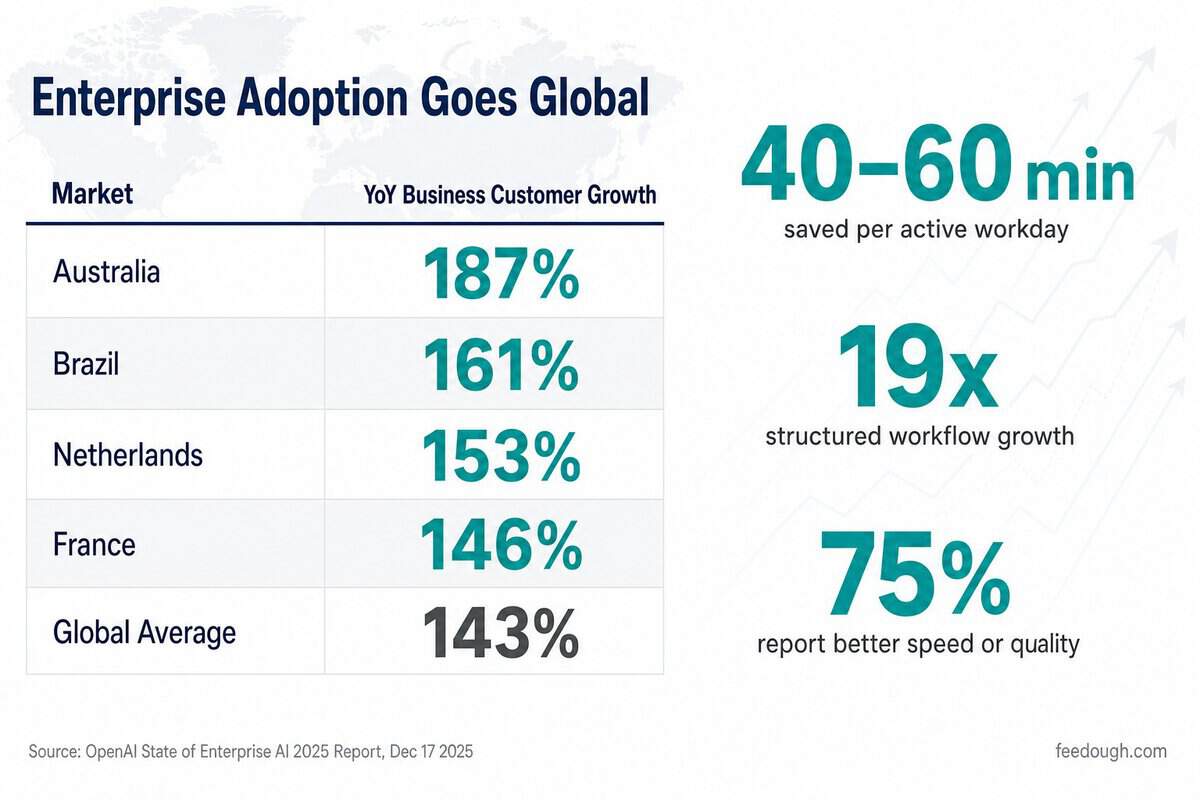
Most enterprise software adoption stories take years to verify. OpenAI’s did not. By November 2025, more than 1 million business customers were on the platform, and by early 2026 that translated into 9 million paying business users relying on ChatGPT for work — a scale that most SaaS companies take a decade to build. The question worth asking at this point is not whether enterprises adopted, but what they are actually doing with it.
Market | YoY Growth in Paying Business Customers (Nov 2024 – Nov 2025) | vs. Global Average (143%) |
|---|---|---|
Australia | 187% | +44 points above average |
Brazil | 161% | +18 points above average |
Netherlands | 153% | +10 points above average |
France | 146% | +3 points above average |
Global average | 143% | Baseline |
UK / Germany | Not separately reported | Highest enterprise customer count outside US |
Japan | Not separately reported | Leads corporate API customers outside US |
International expansion is running ahead of most forecasts. Every one of the largest non-US markets grew faster than 143% year-over-year, per OpenAI’s State of Enterprise AI 2025 Report (December 17, 2025), which measured growth across more than 1 million business customers. These OpenAI enterprise statistics also capture what adoption looks like once it matures: workers using ChatGPT Enterprise report saving 40 to 60 minutes per active workday on average, with data science, engineering, and communications workers saving 60 to 80 minutes. Structured workflow usage (Projects and Custom GPTs) grew 19x year-to-date, with roughly 20% of all Enterprise messages now flowing through tailored assistants rather than open-ended queries. That shift from casual use to repeatable, integrated processes is the operational signal that 80% Fortune 500 adoption within nine months of launch was pointing toward. And across a survey of 9,000 workers at nearly 100 enterprises, 75% reported improved speed or quality of output, while another 75% reported completing tasks they previously could not perform at all.
OpenAI Computing Infrastructure Statistics
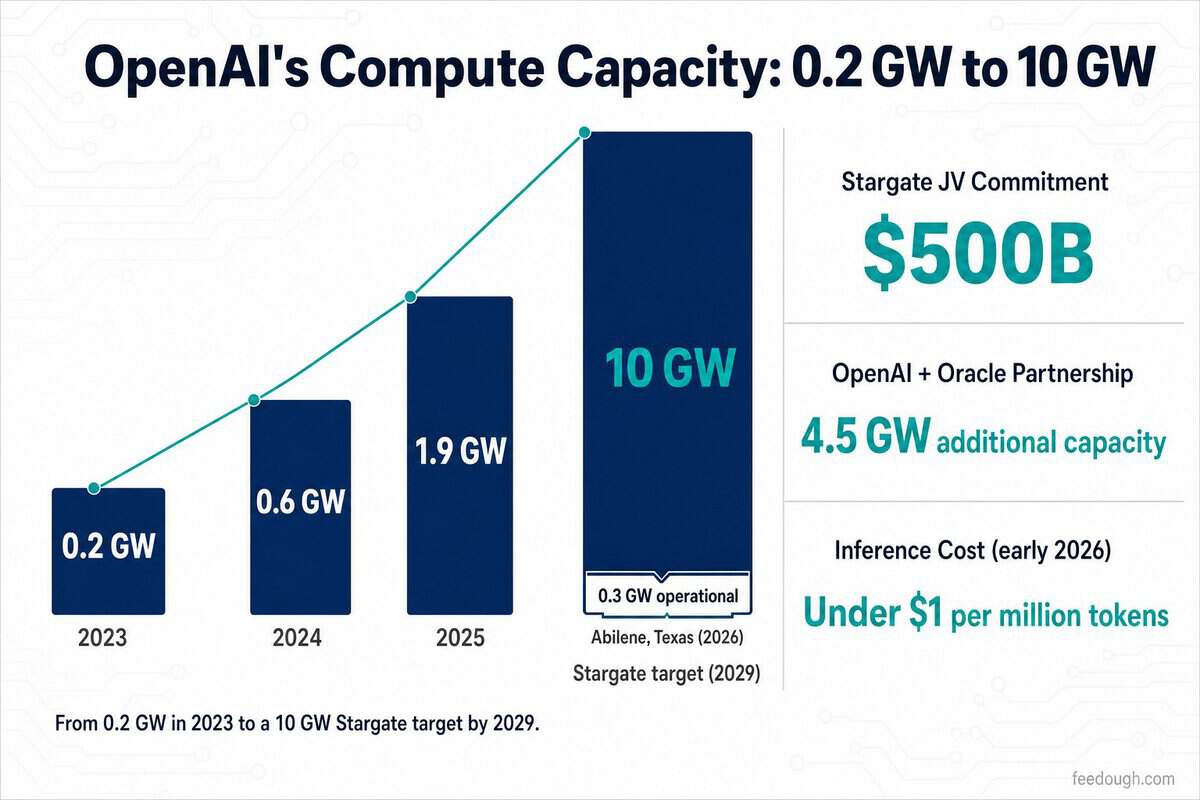
The Stargate program is targeting 10 gigawatts of AI data center capacity by 2029. To understand what that number means, consider the starting point: OpenAI ran its entire operation on 0.2 GW in 2023. The trajectory from there to 1.9 GW by the end of 2025 (confirmed by OpenAI CFO Sarah Friar in her January 18, 2026 blog post) already represents a nearly 10x expansion in two years. Stargate adds another order of magnitude on top of that.
Year / Period | Capacity (GW) | Key Context |
|---|---|---|
2023 | 0.2 GW | Baseline; equivalent to ~175,000 average U.S. homes |
2024 | 0.6 GW | 3x year-over-year increase; confirmed by OpenAI CFO |
End of 2025 | 1.9 GW | 9.5x growth from 2023; sufficient to power ~1.66 million U.S. homes |
Stargate Abilene flagship (April 2026) | 0.3 GW operational | ~250,000 H100-equivalent chips; full 1.2 GW buildout projected Q4 2026 |
Stargate total target (2029) | 10 GW | $500B JV between OpenAI, SoftBank, and Oracle; ~7 GW planned across all U.S. sites by September 2025 |
These OpenAI infrastructure statistics carry more weight when read alongside the specific financial commitments behind each capacity milestone:
- OpenAI and Oracle agreed to develop up to 4.5 GW of additional Stargate capacity across new Texas, New Mexico, and Midwest sites, in a partnership exceeding $300 billion over five years, confirmed by OpenAI’s September 23, 2025 Stargate expansion announcement
- SoftBank and OpenAI jointly invested $1 billion in SB Energy in January 2026 to support the 1.2 GW Milam County, Texas Stargate campus, with SB Energy serving as the energy infrastructure developer for that site
- OpenAI reduced its inference cost to under $1 per million tokens as of early 2026, achieved partly by mixing different types of data center hardware, per OpenAI CFO Sarah Friar’s January 18, 2026 blog post
- OpenAI’s partnership-based model with cloud providers and data center operators (rather than building owned facilities) enabled the 0.2 GW to 1.9 GW expansion without the capital intensity of direct construction
The inference cost reduction to under $1 per million tokens is the metric that connects infrastructure scale to commercial viability: as capacity grows and hardware mixing improves efficiency, the per-query cost compresses, which is what makes the 2.5 billion daily prompts sustainable at a price point that retains users.
OpenAI Website Traffic and Engagement Statistics
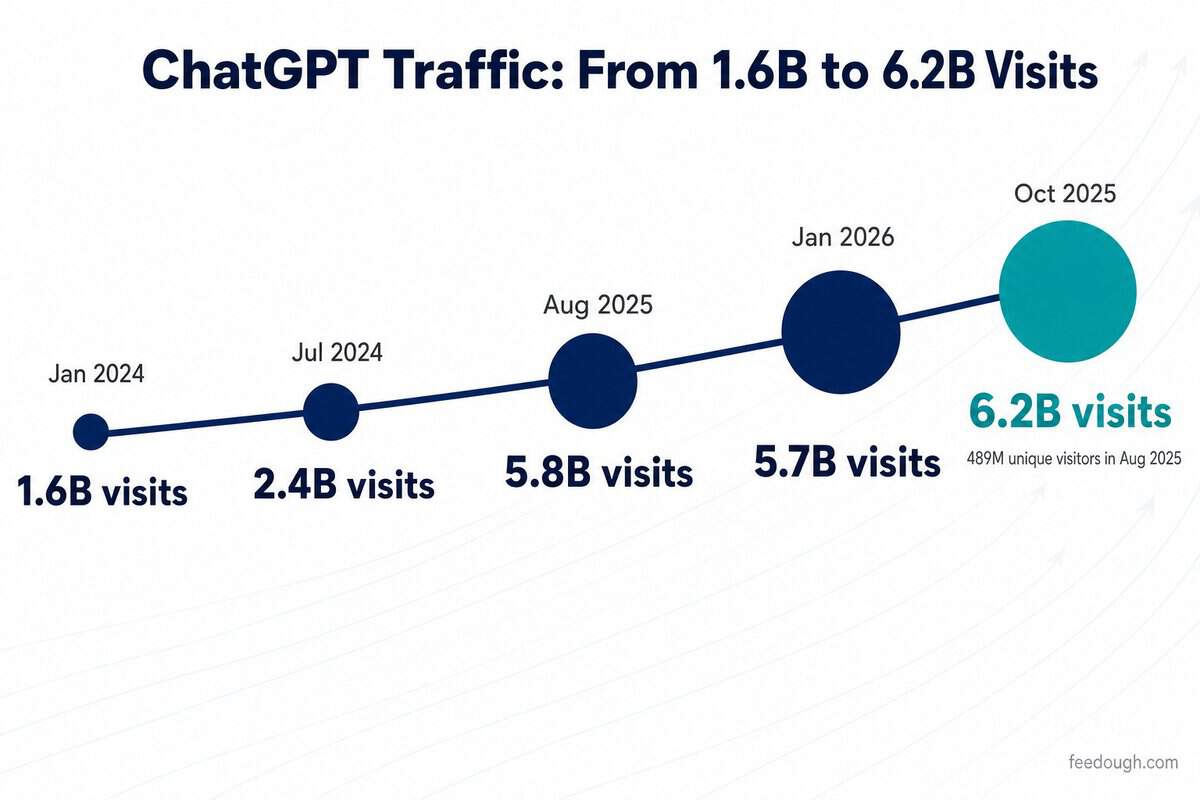
A platform that crosses 6 billion monthly visits is no longer competing with other AI tools. It is competing with search engines and social media for a share of daily internet time. ChatGPT crossed that threshold by October 2025, reaching 6.2 billion visits in a month, up from 1.6 billion in January 2024. That trajectory covers 22 months and a nearly 4x increase in traffic volume.
Period | Monthly Visits | Context |
|---|---|---|
January 2024 | 1.6 billion | First major monthly visit milestone publicly reported |
November 2023 | ~1.7 billion | Corrected figure; original article misattributed this to July 2024 |
July 2024 | 2.4 billion | Surpassed January 2024 figure; per Similarweb data via Textero.io |
August 2025 | 5.846 billion | 489 million unique visitors; 115.9% year-over-year growth in late 2024 |
January 2026 | 5.723 billion | 4th highest month on record at the time; 3.73% month-over-month growth |
October 2025 | 6.2 billion | Highest monthly visit total reported through early 2026 |
These OpenAI website traffic statistics also capture who is arriving and how long they stay. As of February 2026, Similarweb reports chatgpt.com’s audience at 53.44% male and 46.56% female, a narrower gap than earlier figures suggested, with the split continuing to close as the platform expands well beyond its early tech-enthusiast user base, per data reported by The Digital Elevator. The openai.com corporate site draws 237.7 million unique monthly visitors generating 663.6 million total visits (April to June 2025), but with an average session of around two minutes, that traffic behaves like discovery browsing. chatgpt.com tells the opposite story: sessions averaging nearly six minutes, a sub-34% bounce rate, and 489 million unique visitors in August 2025 alone. The gap between those two properties is the clearest measure of what visit volume actually means once users reach the product.
Microsoft OpenAI Partnership Statistics
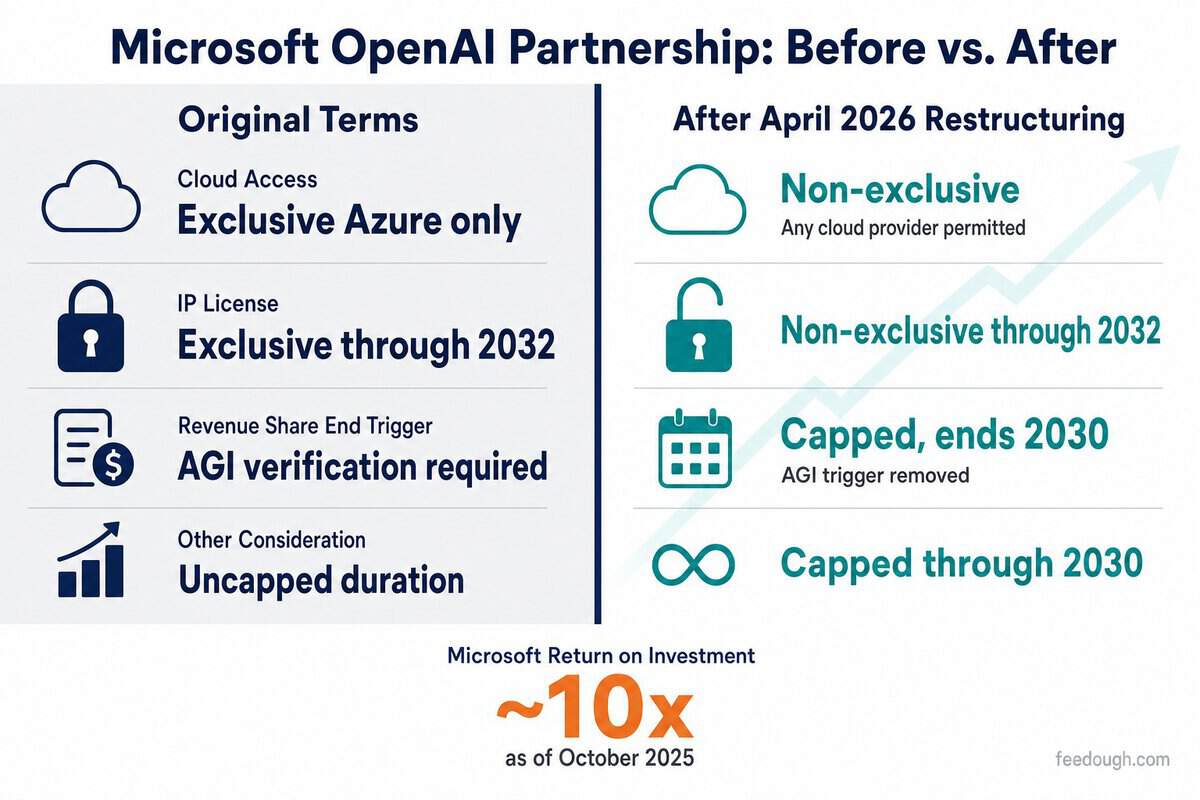
Microsoft’s investment in OpenAI has returned approximately 10x as of October 2025, per CEO Satya Nadella’s remarks at Microsoft’s fiscal Q1 2026 earnings call. That return has come alongside an agreement that looks almost nothing like the one Microsoft originally signed. The April 27, 2026 restructuring removed exclusivity, capped the revenue share, ended the AGI-linked termination trigger, and converted Microsoft’s IP license from exclusive to non-exclusive, all in a single renegotiation.
Partnership Term | Original / Prior Structure | After April 27, 2026 Restructuring |
|---|---|---|
Total Microsoft investment committed | $13 billion total commitment; $11.6 billion funded as of September 2024 | Unchanged; $3.1 billion equity method hit to Microsoft net income in fiscal Q1 2026 |
Microsoft stake in OpenAI Group PBC | ~32.5% on as-converted basis (prior for-profit structure) | ~27% on as-converted diluted basis; valued at ~$135 billion at October 2025 recapitalization |
Cloud relationship | Exclusive Azure partnership for OpenAI API products | Non-exclusive; OpenAI launches first on Azure unless Microsoft cannot support required capabilities, but may serve any cloud provider freely |
Revenue share (OpenAI to Microsoft) | ~20% of OpenAI revenues; ends when AGI verified by independent expert panel | Capped total; continues through 2030 independent of AGI status; AGI-linked termination trigger removed |
Revenue share (Microsoft to OpenAI) | Microsoft paid OpenAI a share of Azure OpenAI Service and Bing revenues relying on OpenAI technology | Microsoft stopped paying OpenAI a revenue share on Azure resales |
IP license | Exclusive license to OpenAI’s models through 2032, excluding consumer hardware | Non-exclusive license through 2032, excluding consumer hardware; other cloud providers may also access OpenAI models |
OpenAI Azure purchase commitment | Not separately disclosed at original deal terms | OpenAI committed to purchasing an incremental $250 billion of Azure services, confirmed October 28, 2025 |
The revenue share payment figures reveal how much was flowing under the prior structure. These Microsoft OpenAI partnership statistics from leaked financial documents reviewed by TechCrunch (November 14, 2025) show OpenAI paid Microsoft $493.8 million in revenue share in 2024, then $865.8 million in just the first three quarters of 2025, a near-doubling of the annual pace. At the 20% rate widely reported for the original agreement, those payments imply OpenAI revenues of at least $2.5 billion in 2024 and $4.33 billion in the first nine months of 2025, figures that align with the company’s confirmed full-year 2024 revenue of $3.7 billion. The April 2026 restructuring capped those outflows and removed the AGI trigger that had given OpenAI a theoretical path to ending the arrangement early. What replaced it is a fixed-term commercial relationship that runs through 2030 regardless of how either company’s technology develops.
OpenAI Employee and Workforce Statistics
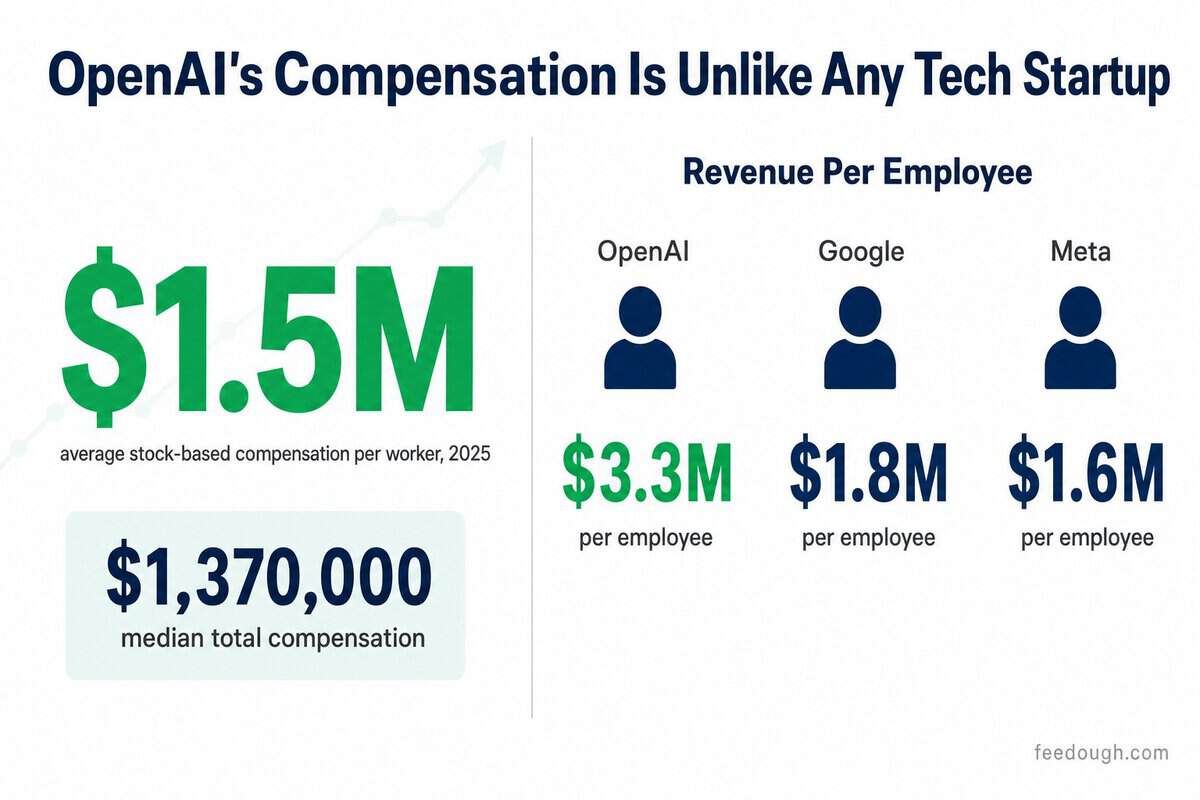
The average stock-based compensation at OpenAI reached $1.5 million per worker in 2025, according to Wall Street Journal financial records reported by Fortune on February 18, 2026. That figure is approximately seven times higher than Google’s inflation-adjusted employee compensation in the year before its IPO, and the highest average equity compensation recorded for any major tech startup. The headcount behind that number grew nearly as fast as the compensation itself.
Date / Period | Employee Count | Context |
|---|---|---|
November 2023 | ~770 | Pre-scaling baseline |
September 2024 | 3,531 | Nearly 5x increase in under a year |
July 2025 | 3,000+ | Confirmed by OpenAI researcher Noam Brown on Twitter, per Epoch AI data published July 15, 2025 |
Early 2025 | 5,328 | Peak figure reported; aggressive hiring across technical and operational roles |
Q1 2026 | ~3,800 full-time | 90% increase from ~2,000 in early 2025; per Searchlab analysis citing LinkedIn, The Information, and Bloomberg |
These OpenAI employee statistics extend beyond headcount into what it costs to attract and retain the workforce building the models. Compensation data from nahc.io’s August 2025 analysis and Fortune’s February 2026 reporting breaks down as follows:
- Median total compensation: $1,370,000 per year, with the 25th percentile at ~$925,000 and the 90th percentile reaching $2,792,200
- Research engineers earn $295,000–$530,000 in base salary; software engineers earn $255,000–$590,000 in base salary
- Revenue per employee at Q1 2026 headcount: approximately $3.3 million, compared to Google’s $1.8 million and Meta’s $1.6 million per employee
- Educational concentration includes Stanford, MIT, and Berkeley, with the majority of roles in AI research and engineering
The $3.3 million revenue-per-employee ratio makes the compensation structure more sustainable than it looks at first glance: OpenAI is generating more output per person than any comparable tech company at this stage, which is partly a function of what the product does and partly a function of keeping headcount disciplined relative to revenue growth.
OpenAI Profit and Loss Statistics
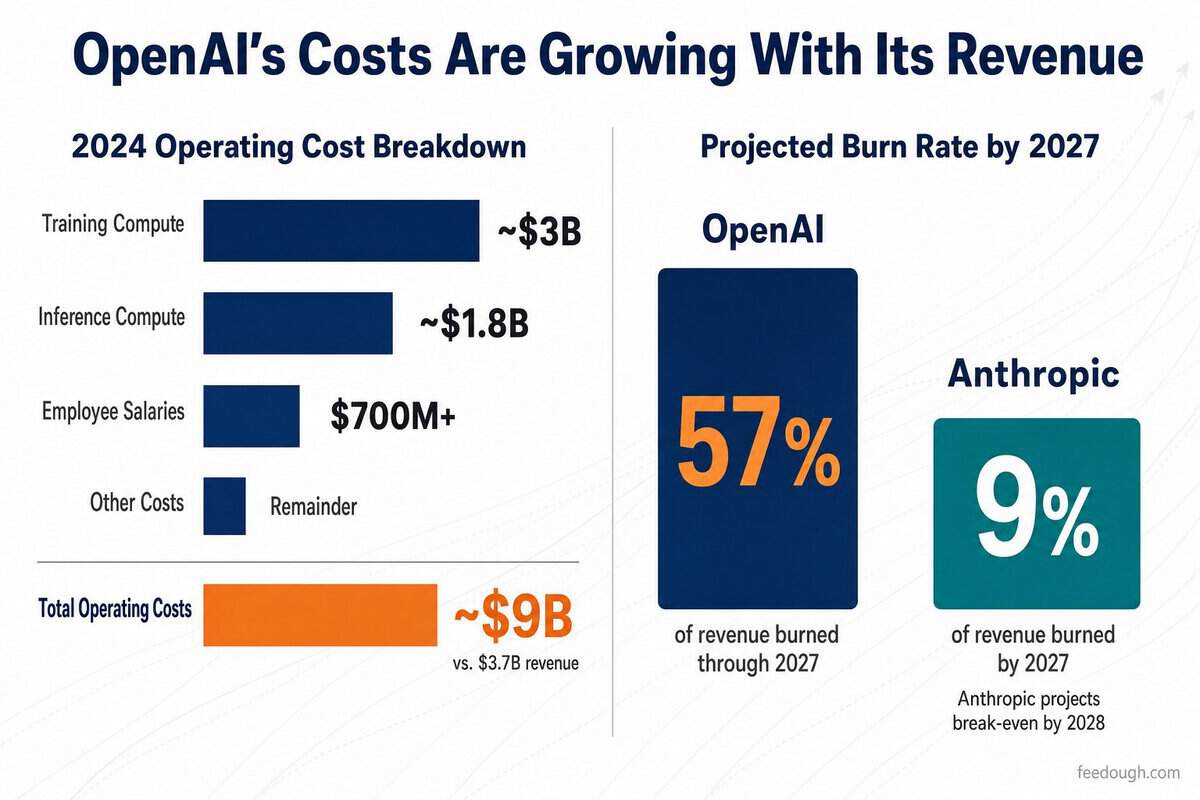
The assumption is that revenue growing at 8x in two years should eventually close a loss gap. At OpenAI, the loss gap grew alongside the revenue. In 2024, the company spent approximately $9 billion in total operating costs while bringing in $3.7 billion in revenue — meaning it spent roughly $2.40 for every dollar it earned, according to Epoch AI’s analysis of OpenAI’s 2024 financials published October 10, 2025, citing reporting from The Information and The New York Times.
Cost Category | 2024 Amount | Source |
|---|---|---|
Training compute (model development) | ~$3 billion | Epoch AI, October 2025 |
Inference compute (running models for users) | ~$1.8–$2 billion | Epoch AI, October 2025 |
Employee salaries (excl. stock compensation) | Over $700 million | Epoch AI / The Information, October 2025 |
Other costs (data, hosting, sales, marketing, infrastructure) | Remainder to ~$9B total | Epoch AI, October 2025 |
Total operating costs | ~$9 billion | Epoch AI analysis of The Information and NYT reporting |
Net loss (excl. equity-based stock compensation) | ~$5 billion | PYMNTS, September 27, 2024 |
These OpenAI profit and loss statistics carry a forward trajectory that is harder to read than the 2024 snapshot. A revised projection (separate from the widely cited $44B cumulative figure) puts cumulative losses through 2029 at $115 billion before profitability arrives in the early 2030s, per a document cited by RD World Online. The original $300 million in monthly revenue that OpenAI achieved in August 2024 (up 1,700% since the start of 2023, per PYMNTS) had already grown to $2 billion per month by March 2026. The losses are growing in parallel: OpenAI’s burn rate is projected to stay at 57% of revenue through 2027, compared to Anthropic, which projects its burn falling to just 9% of revenue by 2027 and expects to break even by 2028, roughly two years ahead of OpenAI’s timeline, according to financial documents analyzed by AI Insights News (March 2026). The gap between those two cost trajectories is the most commercially significant number in the AI industry right now, and it is not a benchmark score.
OpenAI Future Projections and Growth Forecasts
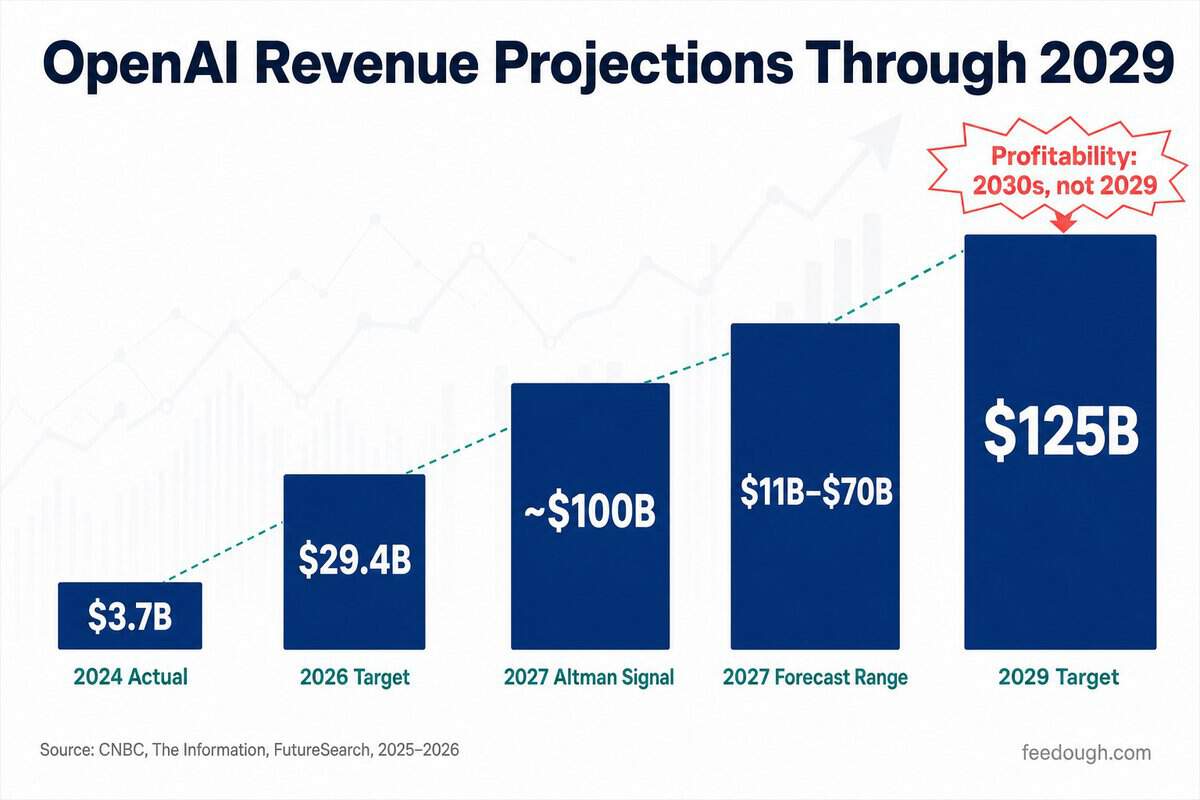
The internal targets are striking. The corrected timeline is more so. OpenAI’s forecasts point toward $125 billion in annual revenue by 2029, but the profitability date that originally anchored those projections (2029) has since been revised: independent analysis of OpenAI’s financial documents, cited by RD World Online, now places break-even in the early 2030s at the earliest. The company will be burning cash at an accelerating rate for longer than its earliest projections suggested.
Year / Target | Revenue Projection | Source / Notes |
|---|---|---|
2024 (actual) | $3.7 billion | Confirmed; baseline for 8x growth calculation |
2026 (internal target) | $29.4 billion | Confirmed by CNBC and The Information; represents ~8x growth from 2024 |
2027 (Altman signal) | ~$100 billion | Sam Altman, November 2025 podcast with Brad Gerstner; two years ahead of prior 2029 projection |
2027 (independent forecast) | $39 billion ARR (80% CI: $11B–$70B) | FutureSearch; expert forecasters Tom Liptay and Dan Schwarz, updated March 30, 2026 |
2029 (internal target) | $125 billion | CNBC, September 26, 2025; breakdown: 50%+ ChatGPT subscriptions, 20% API, 20% new products |
2034 (global AI market) | $3.68 trillion (market context) | Precedence Research; 19.2% CAGR from $638B in 2024/2025 |
The FutureSearch confidence interval is the most honest number in this section. An 80% range of $11 billion to $70 billion for 2027 ARR reflects what an OpenAI growth forecast actually contains: a company expanding at an unprecedented pace into a market (agentic AI) that barely existed two years ago. The agentic AI market is now estimated at $40 billion in 2026 (range: $33B–$48B), projected to reach $140 billion by 2030 in the base case, per Information Matters’ Q1 2026 Agentic AI Market Report. OpenAI’s own internal forecast assigns nearly $25 billion of its projected $125 billion in 2029 revenue to agents and free-user monetization combined, per The Information. That is the segment where the projection is most dependent on a market that still has to develop.
The cash burn trajectory underneath these targets runs in the opposite direction from profitability. Annual losses are projected to more than double to over $17 billion in 2026, then reach $35 billion in 2027 and $45 billion in 2028, per The Information’s September 2025 report cited by CNBC on September 6, 2025. Whether the $125 billion revenue target is achieved in 2029 or whether Altman’s $100 billion-by-2027 signal proves accurate, the company will have consumed an extraordinary amount of capital to get there. The global AI market growing from $638 billion to $3.68 trillion by 2034 provides the addressable space. Whether OpenAI can maintain its technology lead long enough to claim a meaningful share of it is the variable no projection can price.
Sources
- https://www.businessinsider.com/chatgpt-users-openai-sam-altman-devday-llm-artificial-intelligence-2025-10 (2025-10-01)
- https://www.cnbc.com/2025/03/31/openai-closes-40-billion-in-funding-the-largest-private-fundraise-in-history-softbank-chatgpt.html (2025-03-31)
- https://techcrunch.com/2025/07/21/chatgpt-users-send-2-5-billion-prompts-a-day/ (2025-07-21)
- https://techcrunch.com/2025/10/06/sam-altman-says-chatgpt-has-hit-800m-weekly-active-users/ (2025-10-06)
- https://www.reuters.com/business/openai-cfo-says-annualized-revenue-crosses-20-billion-2025-2026-01-19/ (2026-01-19)
- https://openai.com/index/march-funding-updates/ (2025-03-31)
- https://taptwicedigital.com/stats/openai (2025-05-18)
- https://www.resultsense.com/news/2025-11-06-openai-1-million-business-customers-fastest-growing-platform (2025-11-05)
- https://www.theverge.com/news/710867/openai-chatgpt-daily-prompts-2-billion
- https://fortune.com/2026/02/05/chatgpt-openai-market-share-app-slip-google-rivals-close-the-gap/ (2026-02-05)
- https://electroiq.com/stats/chatgpt-statistics/
- https://openai.com/index/how-people-are-using-chatgpt/
- https://www.cnbc.com/2026/02/20/openai-resets-spend-expectations-targets-around-600-billion-by-2030.html (2026-02-20)
- https://epoch.ai/data-insights/openai-revenue (2025-08-01)
- https://www.pymnts.com/artificial-intelligence-2/2025/openai-half-year-revenue-jumps-16-to-4-3-billion/ (2025-09-29)
- https://openai.com/index/accelerating-the-next-phase-ai/ (2026-03-31)
- https://www.cnbc.com/2026/03/31/openai-funding-round-ipo.html (2026-03-31)
- https://mlq.ai/news/openai-revises-projections-upward-with-112-billion-extra-cash-burn-by-2030/ (2026-02-21)
- https://tracxn.com/d/companies/openai/__kElhSG7uVGeFk1i71Co9-nwFtmtyMVT7f-YHMn4TFBg/funding-and-investors (2026-02-27)
- https://www.aiprm.com/openai-statistics/ (2025-04-01)
- https://om.co/2026/05/01/what-microsofts-10-q-says-about-openai/ (2026-05-01)
- https://fortune.com/2025/10/02/openai-valuation-reaches-500-billion-topping-musks-spacex/ (2025-10-02)
- https://fortune.com/2025/11/12/openai-cash-burn-rate-annual-losses-2028-profitable-2030-financial-documents/ (2025-11-12)
- https://techcrunch.com/2026/02/27/chatgpt-reaches-900m-weekly-active-users/ (2026-02-27)
- https://www.cnbc.com/2025/08/04/openai-chatgpt-700-million-users.html (2025-08-04)
- https://wytlabs.com/blog/chatgpt-statistics/ (2025-09-15)
- https://www.similarweb.com/blog/marketing/seo/most-used-ai/ (2025-09-01)
- https://techcrunch.com/2025/12/18/chatgpts-mobile-app-hits-new-milestone-of-3b-in-consumer-spending/ (2025-12-18)
- https://sensortower.com/blog/state-of-ai-apps-report-2025 (2025-07-01)
- https://www.similarweb.com/top-websites/ai-chatbots-and-tools/ (2026-03-01)
- https://www.similarweb.com/top-websites/ (2026-03-01)
- https://www.voronoiapp.com/technology/ChatGPT-Dominates-AI-Market-Share–6127 (2025-08-07)
- https://www.pewresearch.org/short-reads/2025/06/25/34-of-us-adults-have-used-chatgpt-about-double-the-share-in-2023/ (2025-06-25)
- https://www.pewresearch.org/internet/2025/12/09/teens-social-media-and-ai-chatbots-2025/ (2025-12-09)
- https://fatjoe.com/blog/chatgpt-stats/ (2026-04-01)
- https://chad-wyatt.com/ai/100-chatgpt-statistics-for-2026/ (2026-01-01)
- https://cdn.openai.com/pdf/a253471f-8260-40c6-a2cc-aa93fe9f142e/economic-research-chatgpt-usage-paper.pdf (2025-09-15)
- https://www.pathfindermarketing.com.au/chatgpt-statistics/ (2025-01-01)
- https://cdn.openai.com/pdf/3c7f7e1b-36c4-446b-916c-11183e4266b7/chatgpt-usage-and-adoption-patterns-at-work.pdf (2025-08-01)
- https://www.voronoiapp.com/technology/OpenAIs-ChatGPT-Hits-Record-5846-Billion-Monthly-Website-Visits-in-August-2025-6532 (2025-09-10)
- https://techcrunch.com/2025/08/08/openai-priced-gpt-5-so-low-it-may-spark-a-price-war/ (2025-08-08)
- https://www.cnbc.com/2024/09/27/openai-sees-5-billion-loss-this-year-on-3point7-billion-in-revenue.html (2024-09-27)
- https://digiday.com/media/in-graphic-detail-the-state-of-ai-referral-traffic-in-2025/ (2025-12-01)
- https://openai.com/index/introducing-gpt-5-for-developers/ (2025-08-07)
- https://openai.com/index/introducing-gpt-5/ (2025-08-07)
- https://openai.com/gpt-5/ (2025-08-07)
- https://www.cnbc.com/2025/08/14/gpt-5-openai-ai-enterprise.html (2025-08-14)
- https://epoch.ai/data-insights/gpt-capabilities-progress (2025-08-29)
- https://menlovc.com/perspective/2025-the-state-of-generative-ai-in-the-enterprise/ (2025-12-31)
- https://www.cnbc.com/2025/10/02/openai-share-sale-500-billion-valuation.html (2025-10-02)
- https://www.zdnet.com/article/anthropic-openai-enterprise-market-share-2025/ (2025-12-31)
- https://www.sahmcapital.com/news/content/enterprise-llm-spend-reaches-84b-as-anthropic-overtakes-openai-according-to-new-menlo-ventures-report-on-llm-market-2025-07-31 (2025-07-31)
- https://openai.com/devday/ (2025-10-06)
- https://openai.com/business/guides-and-resources/the-state-of-enterprise-ai-2025-report/ (2025-12-17)
- https://www.getpanto.ai/blog/openai-statistics (2026-01-01)
- https://openai.com/index/introducing-chatgpt-enterprise/ (2023-08-28)
- https://cdn.openai.com/pdf/7ef17d82-96bf-4dd1-9df2-228f7f377a29/the-state-of-enterprise-ai_2025-report.pdf (2025-12-17)
- https://openai.com/index/a-business-that-scales-with-the-value-of-intelligence/ (2026-01-18)
- https://www.datacenterdynamics.com/en/news/openai-cfo-says-company-ended-2025-with-19gw-of-compute-scaled-revenue-at-same-speed/ (2026-01-19)
- https://siliconangle.com/2026/01/19/openai-reveals-data-center-capacity-tripled-1-9gw-2025/ (2026-01-19)
- https://openai.com/index/five-new-stargate-sites/ (2025-09-23)
- https://epoch.ai/blog/openai-stargate-where-the-us-sites-stand (2026-04-17)
- https://www.hpcwire.com/off-the-wire/softbank-and-openai-invest-1b-in-sb-energy-to-support-stargate-ai-data-center-buildout/ (2026-01-12)
- https://textero.io/research/chatgpt-users-statistics-2025 (2025-10-01)
- https://thedigitalelevator.com/blog/chatgpt-statistics/ (2026-01-01)
- https://www.advancedwebranking.com/blog/google-vs-chatgpt-who-wins-ai-search-race (2025-12-18)
- https://www.cnbc.com/2025/10/29/microsoft-open-ai-investment-earnings.html (2025-10-29)
- https://openai.com/index/next-chapter-of-microsoft-openai-partnership/ (2025-10-28)
- https://redmondmag.com/articles/2026/04/28/microsoft-openai-restructure-partnership.aspx (2026-04-28)
- https://techcrunch.com/2025/11/14/leaked-documents-shed-light-into-how-much-openai-pays-microsoft/ (2025-11-14)
- https://www.cnbc.com/2026/04/27/openai-microsoft-partnership-revenue-cap.html (2026-04-27)
- https://blogs.microsoft.com/blog/2025/10/28/the-next-chapter-of-the-microsoft-openai-partnership/ (2025-10-28)
- https://fortune.com/2026/02/18/openai-chatgpt-creator-record-million-dollar-equity-compensation-ai-tech-talent-war-career-retention-sam-altman-millionaire-staff/ (2026-02-18)
- https://searchlab.nl/en/statistics/openai-statistics-2026 (2026-01-01)
- https://www.nahc.io/blog/openai-salaries-what-employees-really-earn-in-2025-9ecfb (2025-08-07)
- https://epoch.ai/data/ai_companies_staff_reports.csv (2025-07-15)
- https://www.pymnts.com/artificial-intelligence-2/2024/openai-reportedly-projects-5-billion-loss-this-year/ (2024-09-27)
- https://thedeepdive.ca/openai-doesnt-expect-to-be-profitable-until-2029/ (2026-05-09)
- https://epoch.ai/data-insights/openai-compute-spend (2025-10-10)
- https://aiinsightsnews.net/openai-14-billion-loss-ai-costs/ (2026-03-01)
- https://www.wheresyoured.at/openai-is-a-systemic-risk-to-the-tech-industry-2/ (2025-01-01)
- https://www.cnbc.com/2025/09/26/openai-big-week-ai-arms-race.html (2025-09-26)
- https://www.cnbc.com/2025/09/06/openai-business-to-burn-115-billion-through-2029-the-information.html (2025-09-06)
- https://techcrunch.com/2025/08/04/openai-says-chatgpt-is-on-track-to-reach-700m-weekly-users/ (2025-08-04)
- https://informationmatters.net/sizing-the-agentic-ai-market-40-billion-now-140-billion-by-2030-if-three-triggers-hit/ (2026-01-01)
- https://www.globenewswire.com/news-release/2025/04/10/3059463/0/en/generative-ai-market-size-expected-to-reach-usd-1-005-07-bn-by-2034.html (2025-04-10)
- https://tomtunguz.com/openai-hardware-spending-2025-2035 (2025-11-01)
- https://futuresearch.ai/openai-revenue-forecast/ (2026-03-30)