Midjourney Prompt Generator
Describe your image idea and get three ready-to-paste Midjourney prompts with the right aspect ratio. Free, no login.
More AI prompt generators
Chat models


Image models


Music

Coding tools


By technique


Type your image idea, pick an orientation and a style. The Midjourney prompt generator then writes three one-line prompts you can paste straight into Midjourney. Each prompt already carries the right –ar ratio. It adds a –no flag only when you listed something to avoid. The tool is free and needs no login. Turning those prompts into images still takes a paid Midjourney plan.
How to Use the Midjourney Prompt Generator
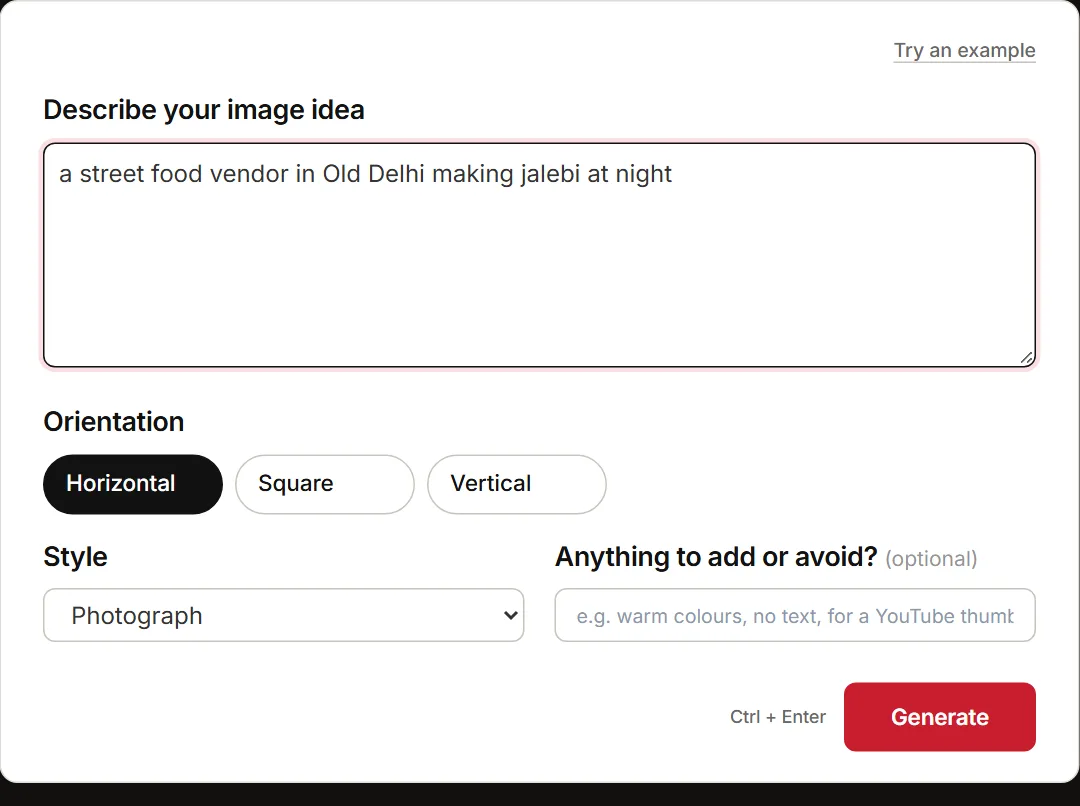
The form has four fields. Only the first one is required. Here is what each choice changes in your prompts.
Step 1: Describe Your Image Idea
Type one plain sentence in “Describe your image idea”. Include the subject, the place and the mood. “A chai stall on a rainy Mumbai street at night” is enough. If you already have a reference picture, run it through the image to prompt generator first. Paste the description it writes into this field.
Step 2: Pick an Orientation
The Orientation dropdown sets the aspect ratio. Square gives –ar 1:1 for an Instagram feed post. Horizontal gives –ar 16:9 for a YouTube thumbnail or banner. Vertical gives –ar 9:16 for Reels, Shorts, Stories and an Instagram Reel cover.
Step 3: Choose a Style
Pick “Give me 3 different styles” and you get one photo prompt, one cinematic film still and one illustration or painting. Choosing a single style locks all three prompts to it. The single styles are Photograph, Cinematic film still, Illustration, Oil or watercolour painting, Anime, 3D render, Product shot and Logo or icon.
Step 4: Add Anything to Include or Avoid
“Anything to add or avoid?” is optional. Anything you want kept out becomes a –no flag. Words that must appear in the image go in double quotes.
Step 5: Copy a Prompt Into Midjourney
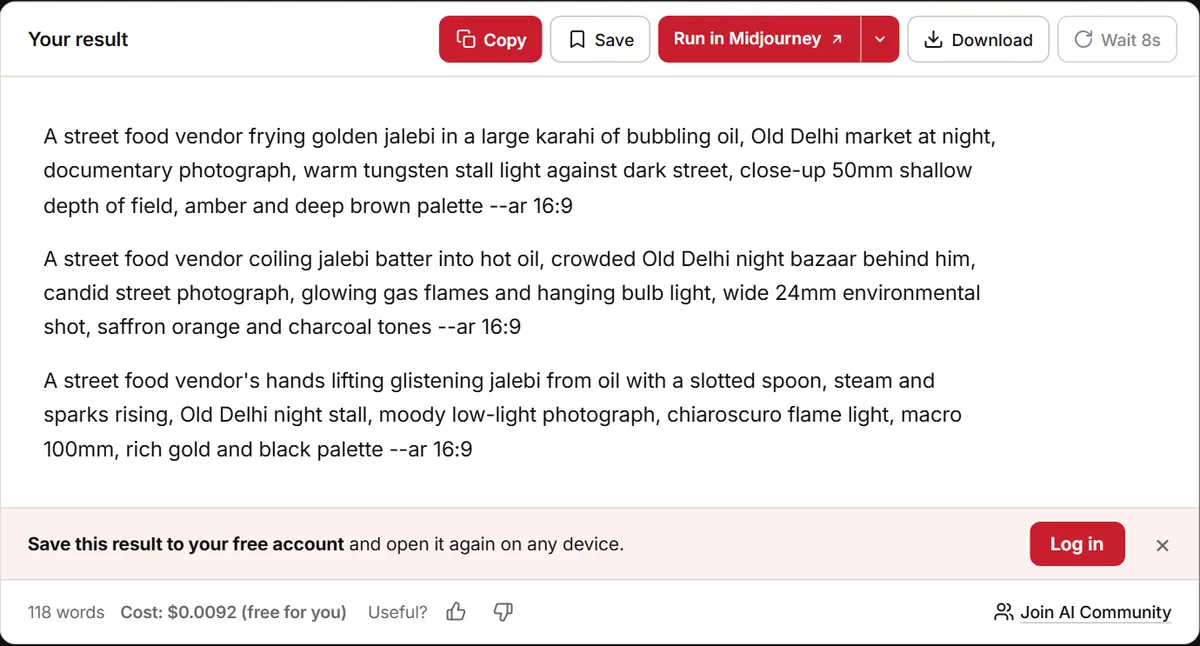
Each prompt comes back as one line of 15 to 45 words. Copy the one closest to what you pictured and paste it into Midjourney.
Real Midjourney Prompts the Generator Wrote
Below is real generator output, run on 13 November 2026. Nothing here is rewritten. Where a prompt is trimmed, it is marked with … Each prompt arrives as one line. The subject comes first, and the parameter sits at the end.
Example 1: “A Tranquil Lake at Dawn” in Three Styles
Input: “A tranquil lake at dawn”, Horizontal, “Give me 3 different styles”. Prompt one:
A tranquil lake at dawn, glassy water reflecting pink clouds, mist rising over distant pine hills, photographic landscape, soft cool morning light, wide-angle 24mm, muted pastel palette of rose, grey and blue –ar 16:9
Prompt two turns the same lake into a cinematic film still. A lone rowboat rests on still water, with golden sunrise rim light and an amber and teal palette. Prompt three paints it as a soft watercolour, with a heron among lily pads and washes of lavender, peach and pale green. All three end in –ar 16:9.
Example 2: Three Logo Prompts for a Bakery
Input: “logo for a bakery called Crumb and Co”, Square, “Logo or icon”, plus “warm brown and cream”. Prompt two shows the text rule best:
Crumb and Co bakery logo, a smiling loaf of bread with steam curls forming a circle badge, flat vector icon style, warm brown and cream palette, centered composition, “Crumb and Co” in rounded serif type beneath the mark –ar 1:1
The brand name sits in double quotes, so Midjourney treats it as text to draw. Prompt one is a flat vector emblem: a rolling pin crossed with a wheat stalk. Prompt three is hand-drawn croissant line art with scattered crumbs. Each ends with –ar 1:1.
Example 3: An Old Delhi Jalebi Vendor, Photographed Three Ways
Input: “a street food vendor in Old Delhi making jalebi at night”, Vertical, “Photograph”. Prompt one:
A street food vendor makes fresh jalebi in Old Delhi at night, lively night market setting, documentary photography, warm tungsten streetlight glow, medium shot, 50mm lens, deep depth of field, rich saffron gold and charcoal palette –ar 9:16
Prompt two is a close-up at 85mm, with golden shopfront backlight and soft neon spill. Prompt three is a full-body wide shot at 35mm, lit by mixed candle and streetlamp light. All three end in –ar 9:16.
How Midjourney Reads Your Prompt
Those prompts follow a few simple rules. Once you know them, you can edit any prompt by hand with confidence.
Specific Descriptions Beat Short Keyword Lists
An independent V8 prompting guide reports that Midjourney favours longer, more specific prompts. A 15-word prompt can do better at about 40 words, when the extra words direct the scene. That is why the generator writes 15 to 45 words. A short keyword list leaves the model guessing at your picture.
The Subject Comes First
Each prompt opens with the subject, then adds details, setting, style, light and palette. Look at the three prompts above and you can read that order in every line. Leading with a small detail can push it to the front of the picture instead.
Words in Double Quotes Become Text in the Image
Only double quotes tell Midjourney to draw text. The same guide says two to four words render reliably, while full sentences break down. A neon sign saying “OPEN 24/7” works. So does a shop sign or wedding card line kept to a few words. A full paragraph does not.
The Midjourney Parameters the Generator Adds, and the Ones It Leaves Out
Parameters are short commands at the end of a prompt, after a double dash. The generator adds two kinds.
–ar Sets the Shape of the Image
–ar gives width to height. The tool uses three: 1:1 for squares, 16:9 for widescreen and 9:16 for tall frames. Choose Vertical and every prompt ends with –ar 9:16.
–no Removes What You Name
–no tells Midjourney what to leave out. The generator adds it only when you listed things to avoid. Type “no text, people” and the prompt ends with –no text, people. Leave that field empty and no –no flag appears.
Why There Is No Version, Style or Stylize Flag
Parameter names change between Midjourney versions. A comparison of V8 and V7 prompts reports that –style raw was renamed –raw in V8. It calls keeping the old name a common slip. So the generator adds no version, style or stylize flag. Your account then runs its own default. That same guide reports the default as V8.2 since 24 July 2026, at the time of writing. Add your own flags by hand if you know your version.
Common Midjourney Prompting Mistakes
If a prompt fails, the setup is usually at fault, not the model. These five slips cause most of the reruns.
- Wrong orientation. A Diwali sale banner made in 16:9 will not fit an Instagram Story. Pick the orientation first, before you write a word.
- Vague subject. “A logo” gives you an anonymous mark. Name the business, the object and the mood: “a Chennai filter coffee shop logo, brass tumbler, warm gold”.
- Two clashing styles in one prompt. A “watercolour photo” pulls the model in two directions. Stick to one style per prompt, or pick “Give me 3 different styles”.
- Changing everything on a rerun. Swap one detail at a time. Then you know which word moved the picture.
- Pasting an old v4 or v5 prompt. Its flags may now be renamed or ignored. Drop any flag you are unsure about.
Midjourney vs Nano Banana and ChatGPT Images
Midjourney is the pick for a styled, art-directed look. Think a moody album art illustration. Nano Banana inside Gemini fits edits to a photo you already have. Ask it to turn your own shot into a retro saree portrait and keep your face the same. ChatGPT Images suits back-and-forth edits. It is also a good pick for designs with more text, like a poster with a headline and offer line.
Each tool reads prompts in its own way. A prompt built for one often lands flat in another. Use the Nano Banana prompt generator for Gemini edits. For other models, the AI image prompt generator is the wider option.
Midjourney Prompt Generator FAQ
Yes. The tool is free and needs no login. Run it again whenever you want new takes.
Yes, to make images. As of 21 October 2026, Dupple reports no free trial on the website or Discord. Basic costs about $10 a month, at the time of writing. The only trial sits in the niji journey mobile apps.
Yes. Change any words and add flags like –stylize if you know your version. Treat the prompt as a draft, not a locked recipe.
Three takes let you pick the closest and rerun it. You skip retyping one prompt from scratch.
The description works in most image tools. Drop –ar and –no where the tool does not use them. Our AI art prompt generator writes for tools beyond Midjourney.